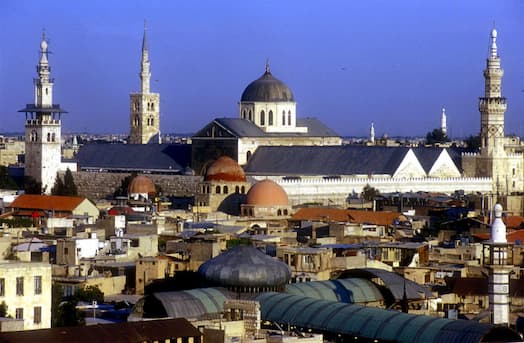
On September 1st 1918, Damascus fell.
Or was liberated – depending on your perspective. It fell to the Arab Revolt, carried out in the name of the Hashemite Prince Faisal of Mecca, and aided by the famous T.E Lawrence.
The capturing of Damascus, the oldest inhabited city in the world, was the climatic moment – and the most lionised – of the conflict.
The Turks were forced to flee.
It is debatable how much that was truly good came from this liberation of the great city ultimately: the pros and cons of the subsequent century of Arab and Middle Eastern history to the present day can be argued over, I suppose.
There were positives and negatives.
On December 8th 2024, Damascus fell again. This time to another revolt of sorts – populated largely by jihadist groups. And this time the Turks – or at least the Turkish state – were in large part behind it.
Given President Erdogan‘s apparent fetish for the Ottoman Empire days, you wonder if modern Turkey’s imperialistic ventures in Syria resonate especially romantically for someone like him.
Also in 2024, as in 1918, the British and other foreign powers had had their fingerprints all over the conflict since its inception. I covered these events here a year ago: and was baffled by how suddenly and quickly it had all transpired.
But history is cyclical, though there are variations in the specific equations.
Either way, you can’t separate the past from the present: historical events and decisions, especially from a century ago, continue to impact the present, particular in Syria and in the Middle East.
I wrote about that here before, regarding the present day legacy of the First World War – and toying with the idea that the First World War never really ended, but simply continued to mutate into other conflicts.
A year on from the fall of Damascus and the inauguration of a ‘New Syria’, it seems a good time to reflect on the changing destiny of this ancient nation: and the surrounding region.
The consistent theme through all the changing equations is that a country like Syria isn’t allowed to maintain its own true sovereignty or determine its own fate.
It appears doomed to be a plaything of Colonial or foreign powers: a mere component of foreign entities’ equations for broader geo-political control.
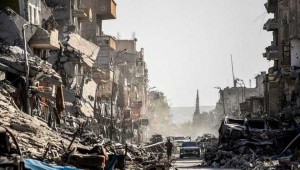
Tragically the only seeming alternative is/was a tightly controlled dictatorship predestined to struggle as an isolated pariah state.
That’s essentially what the Assad family was maintaining in Syria for decades: for better or for worse.
Damascus a century ago was liberated by Faisal’s Arabs, and the liberators had believed the great and historic city – the jewel of the Arab world – would become the capital of a unified Arabia.
The British and French Colonial powers had other ideas, however – preferring to carve up the region into small states and ethnic divisions that would forever feud and contend with each other instead of having any shared purpose or identity.
It was the simple formula of divide and control.
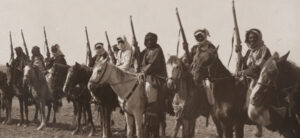
The history of Syria, and most of the surrounding states, to this day has been very much a consequence of those imperialist decisions a hundred years ago.
Power struggles between sects and ethnic groups, conflicting agendas and loyalties, states scheming against fellow Arab states, proxy armies, and the extreme weaponisation of religious ideologies.
Creating order or stability in those conditions isn’t easy: and perhaps this was by design.
The Arab Nationalist projects – inspired largely by General Nasr in Egypt, but including Gaddafi’s Libyan state, the Baathist regime in Iraq, and the Assad-centered Syrian state – were the closest thing these countries came to a form of stability, prosperity and some semblance of unity.
Even if a lot of the ‘unity’ was only surface level: and held together by fear of the alternatives.
As imperfect and ugly as they often were – they were dictatorships, after all – they created relative cultural harmony in pluralistic societies, and promoted a unifying national identity under a broadly secular vision.
There were serious problems within those systems – violent suppression of dissent, harsh policing, and the general abuses and crimes we associate with dictatorship.
But, in the absence of the unified Arabia that the World War I Arab Revolt had envisioned, it seems to have been the best the Arab states could do with what the British and the French had limited them to.
Needless to say, I’m not here to play devil’s advocate for dictatorships. Only to acknowledge pragmatically that these regimes provided stability and coherent nation statehood: and they preserved and protected the delicate tapestry of cultural and ethnic heritage.
The secular outlook of these regimes was essential too: because having one sect or ethnic group wield too much power over other groups would always cause conflict in multi-ethnic or multi-religious lands.
That’s why everyone from the Iraqi, Syrian and Egyptian states to Gaddafi’s Libyan Arab Republic, to even the Palestinian national movement under the Arafat leadership, maintained a broadly secular ideology that was trying to avoid alienating any of the ethnic or religious communities in the society.
In the twenty first century, the West – or primarily the Americans, the British and Israel – apparently decided that even all of this had to be demolished: and that the sectarian divisions and factionalism should be encouraged instead.
Thus began the new destabilisation of the Middle East, beginning with the decimation of the Iraqi state: which immediately opened the Pandora’s Box of Shia-Sunni sectarian conflict, and began the destabilisation domino effect in the region.
Israel funded and encouraged the Islamism of Hamas in order to displace the secular and pluralistic PLO (read more here). Likewise, the West and its Saudi and Gulf State allies funded and supported religious extremists to topple the Libyan state.
And again, a years-long attempt to collapse the Syrian state by arming and supporting various militant groups and flooding the country with foreign fighters.
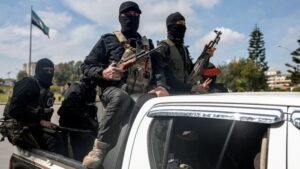
Which finally succeeded one year ago – led by rebranded militants formerly aligned with the Al-Qaeda and Islamic State groups.
But again, remembering the omnipresence of history, we often must look to the past.
I don’t think there’s any real ideological comparison between the modern day Syrian rebels and the Arab Revolt of a century ago. The latter were fighting to gain regional independence from a foreign regime.
And whereas Faisal’s claim to Syria was ultimately delegitimised and rejected by the Western powers, the militias under Mohammad al-Julani (or ‘Al-Sharah’) have been generally endorsed by the US, Britain, Israel and the Gulf States.
Whether this was ever a truly ‘Syrian Revolution’ or simply a regime change project orchestrated from overseas will always be a question.
I’ve argued the latter here for years: but I’m willing to acknowledge it may have been an uncertain mixture of both.
And whether Syria will ever become a functioning, unified state again is also unclear. Libya, some sixteen years after its own foreign-orchestrated dismemberment, still isn’t anywhere close to being a functioning, coherent nation state.
Dismemberment (without repair) might have always been the plan. In which case, the contemporary strife in Syria might be a microcosm of what the former Colonialist powers did to the broader Arab world a century ago.
A simple divide and control strategy.
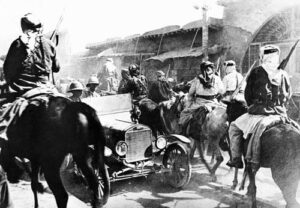
The thing that the contemporary ‘liberators’ of Damascus might actually have in common with the Arab army of a century ago is the idea of unfulfilled visions and broken promise.
While different people presently have mixed or conflicting feelings about the modern fall (or ‘liberation’) of Damascus, I keep thinking of the melancholic T.E Lawrence sentiment in his famous chronicle of the Arab Revolt, The Seven Pillars of Wisdom.
The line about how the old men, the establishment figures and puppet-masters, ‘came and took our victory and remade it in the image of the former world they knew’.
In other words, the victory the rag-tag Arab fighters had thought they had won, the future they thought they were fighting for, was never really going to happen.
They were just foot soldiers, ultimately fighting to accomplish someone else’s agendas and interests. The ideologically driven fighters on the ground might have a certain vision or hope. But their foreign sponsors and enablers might have different ideas.
The now apparently ‘free’ Syrians might want certain things. But what do the militias want? And what does Turkey and its Neo-Ottoman Sultan want? What does Israel and the Zionist movement – co-sponsors of the regime change – want?
What does the West want?
These precise same questions were being asked a hundred years ago, after the Arab Revolt’s conquest of Damascus.
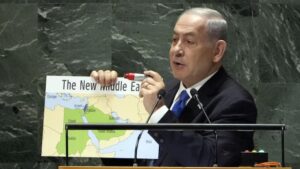
The Zionists had only just been installed in Palestine at that point by the Rothschild-controlled British: but the land grabs were underway, and the ‘New Middle East’ was being carved up right then – just as Netanyahu and co are talking about today.
The promises of the foreign powers had meant nothing. Faisal, a supposed descendent of the Prophet Muhammad, was driven out of Syria by the French – just as his family had been driven out of Mecca and Medina by the British-installed House of Saud.
Today, all the foreign powers who’ve invested in this Syrian conflict arena – they have their own interests to maintain still.
And it might not match up with the hopes of ordinary Syrian people: nor even of the various fighters who’ve done all the hard, bloody work on the ground.
Remember – the British and Americans, the Israelis and the Gulf States, and various foreign intelligence agencies essentially *created* the Islamic State entity to help facilitate its objectives: and then ended up bombing the crap out of those same proxies a short while later.
Indeed, the US has just bombed ISIS targets again in Syria. Israel has also bombed substantially in Syria since the collapse of the Assad government: and has seized territory. Some of the same sponsors who supported the overthrow of the old regime aren’t exactly treating the newly ‘liberated’ nation with respect for its sovereignty.
And sectarian violence and division has predictably unfolded too (as we examined here).
Proxies, foot soldiers, stooges or useful idiots – whatever we want to call them – outlive their usefulness eventually.
And whatever the well meaning people who were celebrating in the streets last December were hoping for beyond the occurrence of regime collapse itself, it might never really come to pass.
Previous contemporary ‘liberations’ in the Arab world have been affairs of false hopes and promises: bloody geo-political schemes driven by external agendas, carried out under the deceptive promise of a brighter future.
Just as it was with the liberators of Damascus a century ago.