Whenever I get into a conversation about what the best Christmas film is, I cite the same handful of movies as my personal picks.
Obvious ones: the original 1947 Miracle on 34th Street or Capra’s universally loved It’s a Wonderful Life.
And then less obvious, Tim Burton’s 1991 animation masterpiece The Nightmare Before Christmas.
But actually it’s 1988’s Scrooged (starring Bill Murray) that has probably been my favourite seasonal movie for most of my life.
It’s a strange one. Because it isn’t the perfect or sweet film that something like Miracle on 34th Street is. Nor is it the creative tour de force that something like Nightmare Before Christmas is. Nor is it quite ubiquitous like Home Alone.
It’s also even odder when you look into the movie’s problematic background: how much Bill Murray hated the experience, how the writers essentially disavowed the finished product, and how it definitely wasn’t universally praised upon release (though it’s gone on to be regarded as a modern classic).
It’s an odd, offbeat movie: dark in places (I’ve seen it described as ‘comedy-horror’), but ultimately just as soft and sentimental in the end as other Christmas fare.
If it’s a slightly odd feeling movie, then it’s appropriate that it had an odd production and development as well. Director Richard Donner famously said Murray was very difficult to work with.
Various changes were made to the script as it went along, much to the disapproval of the original writers (who believed their vision of the film was greatly deviated from). And Murray ad-libbed a lot of his lines. That’s particularly significant in terms of the film’s climatic scene: but we’ll get to that.
A Danny Elfman score helps maintain the offbeat feeling too. Which makes me wonder what a Tim Burton version of this film would be like: I don’t think it would be all that different, except I imagine it would have a less feelgood ending.
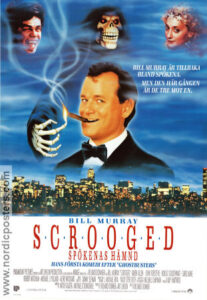
Scrooged, for anyone who hasn’t seen it, is a kind of meta adaptation of Dickens’ A Christmas Carol.
It’s pretty much the Ebeneezer Scrooge story transferred to the nineteen eighties era of greed and rampant commercialism. The fact that it’s set in New York probably isn’t coincidental either, with its Wall Street connotations: in fact Murray’s character makes an unflattering reference to Trump Tower in one scene.
Also the fact that it’s a modern Christmas Carol narrative overlaid on top of an actual Christmas Carol TV production in the story is really clever. Frank Cross’s nightmarish experience overlaps with the staged Christmas Carol production in all the right places.
Murray plays a ruthless TV executive whose only interest is the ratings for the live Christmas Eve broadcast. The bitter, deadpan Frank Cross seems like a role Bill Murray was born to play: a sarcastic, mean exec who considers everyone else to be beneath him and lacks either sentiment or empathy.
Naturally, he is visited by Three Ghosts w ho’ll show him the error of his ways before it’s too late.
And the rest unfolds more or less as you’d expect.
But it’s not the straightforward and obvious plot that makes this film work: it’s everything else.
Murray’s strange, uneven performance. Genuinely weird moments, even when they’re supposed to be funny. Some truly memorable supporting characters, particularly Carol Kane‘s Ghost of Christmas Present (who steals every scene she’s in).
The fact that Carol Kane plays the Ghost of Christmas Past as not just quirky but mentally unstable is one of the best things in the movie. Her casual violence towards Frank is, we can assume, based on her feelings about him being such a horrible person.

According to Kane, she actually physically hurt Murray in some of the violent scenes: which presumably added to Murray’s bad experience making the movie.
David Johansen is also really great as the cab-driving Ghost of Christmas Past. Johansen sadly passed away earlier this year after a long illness. But the fact that the lead singer of the New York Dolls portrays a Christmas Ghost is one of the various offbeat ingredients that makes this unbalanced movie particularly memorable.
There’s a lot of that. Jazz legend Miles Davis appears in an early scene in a street band, playing his stylised version of ‘We Three Kings’ (well worth a listen).
It’s also odd to have an old-timey Hollywood star like Robert Mitchum appear in such a small role.
Casting Bobcat Goldthwait as the down-on-his-luck Elliot Loudermilk was also perfect. Criminally under-cast by movie producers in general, he brings so much of his unique energy to the film. Given the era, an obvious casting choice I can imagine for this role would’ve been Rick Moranis: but I’m glad it was Bobcat. His weird verbal delivery is perfect for this film, especially when he’s hunting down Cross with a rifle at the end.
Also in terms of casting, it’s Alfre Woodard as Mr Cross’s ill treated assistant and Karen Allen as his estranged girlfriend that provide the humanity or common decency in the story. Both do so really well.
Without those two performances, the film would just be off the rails, as Murray himself isn’t portraying a stable person.
It’s a film of oddities. The ending is probably the oddest part: considered by some to be the thing that spoils the film by being overly sentimental and emotional.
I used to think that too. Bur over time I’ve realised this film can’t work without that ending.
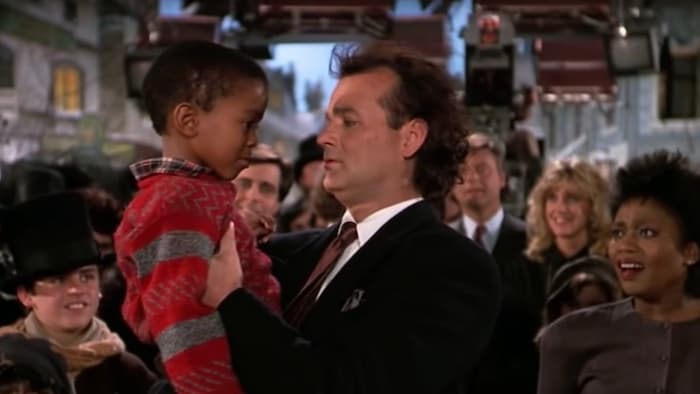
That finale is basically Murray’s character hijacking the live broadcast and addressing the cameras (and the TV viewing audience) directly, as he tries to convey the true meaning of things and to also apologise for the person he’s been.
I used to agree that this climatic sequence feels off somehow. Maybe it goes on too long. Maybe there’s too much sentimentality.
But I feel that way less and less.
You can’t end the story with Murray’s character still being sarcastic and unemotional. This is, after all, a retelling of the Scrooge story – and Scrooge undergoing his transformation at the end is the whole point.
Also, what’s interesting about this scene is learning about how much of it was ad-libbed by Murray, who had apparently not been enjoying the experience at all.
Some of it definitely feels ad-libbed and unscripted. But that’s kind of perfect: because the scene is about Mr Cross hijacking the broadcast and doing an off-the-cuff, heart-on-sleeve address to the viewing audience.
So having Murray actually making some of it up as he goes along gives it a weird sort of authenticity.
The bits where he gets genuinely emotional, with cracks in his voice or tears in his eyes were, according to some sources, not acting – but actually a result of Murray’s mental state and the stress levels he apparently experienced during filming the movie.
Which makes this finale even odder to watch.
One of the writers is even quoted as thinking on set that Murray was having a ‘mental breakdown’.
Yet that scene does make me a little emotional: particularly the moment where the young mute boy finally speaks (to add the Tiny Tim line to Murray’s monologue: “God bless us, every one”).
Does it push a bit too far? I don’t think so. I love It’s a Wonderful Life, but that’s a film that does push too far with its sentimental ending, with even James Stewart’s performance towards the end becoming a bit grating.
But Wonderful Life and James Stewart get away with it because of the year it was made.
You’d never get that kind of overly emotional reading out of a Bill Murray: the emotion he shows here isn’t overt, but rather something that breaks through in awkward spurts – something that’s been suppressed for a long time. That fits the character perfectly.
More broadly, I’ve seen it said that Scrooged has even stronger resonance today – in terms of rabid commercialism, corporate callousness, the obsession with ratings and with commodifying the season, etc.
But actually I think it’s a very eighties movie with a very eighties resonance. And again, that’s also part of its charm.
It has very eighties references too, which might go over the heads of most younger viewers. There’s a barbed reference to Richard Pryor being on fire, for example – referring to the real life incident where Pryor accidentally set himself alight and ran down the street in flames.
It’s an odd thing to make a joke of, given that Pryor nearly died. Yet the visual gag that accompanies the line is genuinely funny: another small example of this film’s odd tone.
Or there’s the scene where the trio of homeless characters mistake Murray’s character for Richard Burton and push him into doing some Mark Antony from Cleopatra. A lot of people these days probably don’t know who Richard Burton is.
It’s even funny to consider that the Trump Tower reference might’ve once been considered a very eighties-specific reference that wouldn’t mean that much decades later. Ye here we are four decades on and Donald Trump is the most famous person in the world.
But all of this strange undercurrent and offbeatness is part of the fun of this film. It feels like a film that could only be made in the eighties.
I mean, with Richard Donner as director, Bill Murray as the main star, Danny Elfman scoring, Annie Lennox singing in the end credits, and even Bobcat Goldthwait getting a prominent role, this is a markedly eighties artifact.
The only way it could be more eighties is to put Eddie Murphy in there somewhere or throw in a Michael Jackson track.
But don’t let the eighties-ness of it put you off. It’s a movie that does speak just as easily to contemporary life.
The same way It’s a Wonderful Life still does: just as it can feel like the real world Mr Potter and Pottersville are at large in the world today, so too can we understand that there are real life Frank Crosses all over the place.
Some of them are pretty much running the world.
What more to say about Scrooged?
A film that sells itself as a comedy, but gets legitimately dark in places (the image of the frozen-to-death beggar that Frank earlier refused to give a dollar to, or the scene of Frank experiencing his own cremation). And a film that aims for classic Christmas sentimentality, but is too oddball to quite find itself in the pantheon of universally approved ‘Christmas classics’.
Yet, despite everything, it has somehow ended up there anyway: more and more people genuinely now seem to regard Scrooged as one of the perennial Christmas fixtures.
I remember a time when I used to mention this film as one of my favourites and lots of people didn’t even know what film I was talking about.
So it has definitely increased in popularity and recognition over the years.
Bill Murray still doesn’t seem to like or care about this movie: possibly because he had such a bad time making it.
The writers seem to actually despise it in its finished form: Michael O’Donaghue once said, “We wrote a fucking masterpiece. We wrote a story that could make you laugh and cry. You would have wanted to share it with your grandchildren every fucking Christmas for the next 100 years. The finished film was a piece of unadulterated, unmitigated shit.”
According to him, the version of this story that was originally written would’ve been considered an all-time classic. Whether this is hyperbole or truth, who knows?
The version we do have is an off-key piece of Christmas oddness. But I think I wouldn’t want it any other way.