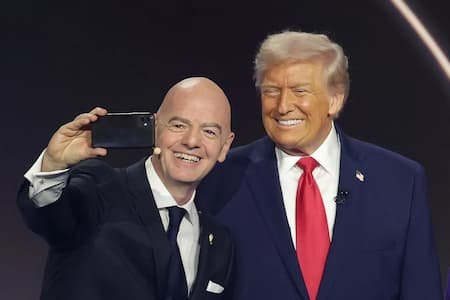
“The greatest World Cup ever…” is what he’s calling it.
Of course he is. And that’s what ‘FIFA peace prize’ winner Trump was saying before any of it had even started. Meanwhile, “Chill” was what the FIFA president said in response to all the complaints and criticisms that have been mounting.
As Mexico and South Africa prepare to open the World Cup with their clash on June 11th, the 2026 tournament is already the most problematic, divisive and unpopular in living memory.
And the United States – or, more to the point, the Trump era United States – has already proven to be an inappropriate or unsuitable host for the biggest international sporting event on the planet.
Funnily enough the last World Cup held in the US (1994) was a generally dull and unmemorable affair, culminating in a lackluster final between Italy and Brazil (a 0 – 0 draw, settled on penalties). All anyone remembers about USA ’94 is Roberto Baggio.
I was about 13 then, but I remember how disappointing that tournament was: especially after the drama and romance of Italia ’90. But at least that tournament unfolded like a normal World Cup.
Somehow, despite all the pre-tournament concerns or controversies involving the two previous hosts – Russia (2018) and Qatar (2022), respectively – both of those competitions managed to unfold smoothly: and certainly neither of them displayed this many problems in the lead-in.
As the tournament approaches, instead of enthusiastic conversations about football, the talk is all about the extortionate ticket prices, fans being priced out of the tournament, supporters from multiple countries being denied entry to the US, and even key participants (like a FIFA referee) being refused entry too.
We’ll get to all those things.
But if course none of this is especially surprising. FIFA is a corruption-riddled organisation, and its current president, Gianni Infantino, is as bad as they come.
Infantino has faced various corruption cases. French football legend Michele Platini is in fact launching legal actin against Infantino over corruption allegations.
More significantly in terms of this current World Cup, he appears to have been in a love affair with the current American president. FIFA’s involvement with Trump’s ‘Board of Peace‘ has also prompted questions, particularly concerning political neutrality.
Infantino in fact showed up to Trump’s ‘Middle East Peace’ pantomime sporting a red MAGA hat with ’45, 47′ on it – referencing Trump’s two terms. He even invented a whole new bullshit award – the ‘FIFA Peace Prize‘ – just so that he could award it to Trump when Trump was throwing his tantrum over missing out on the equally bullshit Nobel Peace Prize.
So, if that’s who’s running FIFA, it’s no wonder we’re looking at a likely shambles of a World Cup.
The 2026 World Cup, secured for the United States during Trump’s first presidency, was obviously acquired via typical corruption. So were Russia and Qatar, no doubt: but at least they understood how to be hosts for an international event.
The acquiring of the 2026 World Cup for the US was clearly a Trump-centered vanity project, which the current regime obviously plans to utilise for propagandistic purposes: with the full cooperation of Infantino and FIFA.
Which is fair enough: that’s just what seems to happen now. Putin used the 2018 World Cup in a similar way at a time when Russia was under a great deal of international scrutiny (pre Ukraine invasion, but post Crimea annexation).
But again, the difference is that Russia understood how to play host. The United States apparently does not.
The US, as it now is, seems to have gone out of its way to bar international visitors from getting to be part of the experience.
There’s also an inescapable sense of an almost apartheid-like discrimination about who is or isn’t being allowed in. As reported here, for example. Fans ‘from more than a quarter of the countries taking part in the World Cup are facing travel bans, tighter restrictions or high visa rejection rates.’
This is part of the broader policy under the Trump administration, where practically no one except white South Africans fleeing a fictional ‘genocide‘ have been allowed in to get US as refugees.
Some of this is also a consequence of Trump’s famous ‘Muslim Ban’ from the first term, which has subsequently been expanded in the second term to include more countries.
But there’s clearly a two-tier approach in play. As the BBC reports, for example: ‘Forty-two generally wealthier countries benefit from a visa waiver programme, where applications are made online through the US’s Electronic System for Travel Authorization (Esta). This costs about $40 (£30). There are no African countries on this list.‘
One supporter from Africa, who was barred from going to the US described the visa system as ‘the invisible gatekeeper of the World Cup’, telling the BBC that “Fifa can sell a ticket, but the US government decides who gets a visa, and CBP [Customs and Border Protection] decides who actually enters.”
As further reported, even with a visa, anyone travelling to America isn’t guaranteed entry, as border officials can still turn people away.
57% of visa applications from Jordanian fans have reportedly been rejected – and Jordan is a US ally, not on any ban list. One Jordanian fan (this is Jordan’s first time being in the World Cup) told the BBC he took more than 42 documents with him to his visa appointment, but his application was rejected – without the US giving him a reason.
Other countries not on the banned list have also been subject to a visa freeze, including Algeria, Brazil, Colombia, Egypt, Ghana, Morocco and Uruguay.

This is a bizarre way to host a World Cup.
And isn’t just supporters being denied participation: even some countries’ football staff and officials have been blocked. Senegal and Ivory Coast have been particularly targeted, but members of Iran’s actual staff have been barred from entering the US.
The case that’s gotten the most attention is Somali referee Omar Artan, who was denied entry after arriving at the airport in Miami. That’s an official FIFA referee being turned away at the airport, despite having all the proper documentation. The justification seems to be an unproven accusation that Artan has terrorist links.
But the obvious question: if they don’t want foreigners from non-white countries coming into the US, then why are they hosting the World Cup – an event that rather famously involves large numbers of supporters from all over the world, including Africa and the Middle East?
In other words, they want the vanity project and the attention, but don’t actually want to act as proper hosts – and don’t seem to understand what the World Cup is.
As a result, multiple competing teams are going to have very limited support from their fans: again, particularly teams from Africa and the Middle East (and especially Iran). This will naturally create a psychological disadvantage.
Iran has in fact complained that its supporters have been denied ticket allocation entirely.
Also, the Iranian team isn’t allowed to be based anywhere in the US, meaning they won’t be housed close to their stadiums like other teams – instead they’ll have to fly in from Mexico on each match day, creating yet another disadvantage.
The fact that Iran is even being allowed to take part still is, I guess, a credit to FIFA. Though having one of the competing nations currently being bombed by the host nation is probably a novel situation for a World Cup.
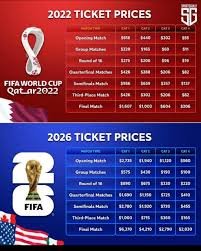
Even putting aside the international issues, the ridiculous ticket prices in general are also likely to exclude even many domestic fans from attending games.
‘Dynamic pricing’ is what they’re calling it. But for the cost of attendance to be this high, especially during a cost of living crisis, is almost a perfect encapsulation of how this World Cup is being conducted.
A tournament being characterised by some already as being for the wealthy and not for average football fans: and certainly not for foreign fans wanting to support their national team.
So while VIP boxes will no doubt be occupied, it’ll be interesting to see whether there are half empty stadiums.
Even the infrastructure and travel logistics in some locations is being flagged up as a big problem for visitors trying to reach stadiums, particularly in locations where public transport systems are severely lacking.
They at least had the sense to make Canada and Mexico co-hosts for the tournament. Neither Canada nor Mexico have instituted travel bans on specific countries (Canada has only placed restrictions on places relating to the recent Ebola outbreak). But the majority of the games are being held in the US, including the final.
It’s possible that this tournament will turn out to be an entertaining one once the actual football starts. But the general feeling seems to be that this World Cup happening in the US right now at all is bad for everybody (except maybe the current US administration, which will naturally milk it for all it’s worth).
Certainly the idea of the World Cup as the great international festival of nationalities and travellers converging together in an enthusiastic host nation is completely absent this time around.