
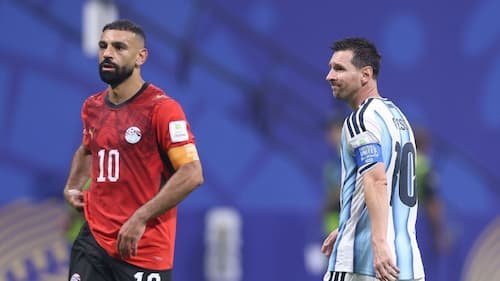
So. The 2026 FIFA World Cup. The biggest show on Earth.
I’ve been working on this article for weeks: but I decided to just let the World Cup fully play out before finishing it, so that I could really take a broader overview of these subjects.
Apologies also for the lack of new content in recent weeks: but I’ve been dealing with the sudden death of someone very close to me.
To anyone uninterested in football, my apologies also: as this is going to be a very in-depth examination.
But, as I said, I’ve been taking notes and preparing this article during the five weeks of competition that concluded on Sunday with that truly awful climax between Argentina and Spain.
I’ve watched every World Cup since 1990: and I’ve never watched one as problematic as this one has been.
While I disagree with those who’ve called it the ‘worst’ World Cup (it’s been too entertaining at times to call it that: Cape Verde’s epic efforts alone were worth the time), there’s no question that there’s been an uncomfortable and unusual undercurrent to the whole affair from the start, both on and off the pitch.
From Trump’s improper interventions to actual implications of match-fixing by FIFA, the ‘Greatest Show on Earth’, despite some fantastic moments, soon became marred by obvious unfairness and suspicions of conspiracy.
There was plenty of controversy at this World Cup: and while we’ll deal with more broader controversies, I also want to focus in primarily on (1) the highly questionable Egypt v Argentina knockout game, (2) the Iranian campaign, (3) the antics of Paraguay and how that might relate to the USA’s campaign, and (4) the Argentina controversies.
There are a lot of questions here. Was Egypt deliberately prevented from claiming victory over Argentina? Was Iran deliberately sabotaged from being able to progress in the tournament? Was Paraguay given a free pass in exchange for helping the US team? Did Austria and Algeria fix their match?
Inevitably, I’ll also touch on the issues surrounding Argentina in general, which becomes a central theme as the tournament reaches its climax: specifically the widely believed idea that the tournament was being fixed for Argentina – and specifically Lionel Messi – to win.
We also need to touch on the political aspects of this: not just the treatment of Iran, which we’ll discuss shortly, but even the significant political dimensions concerning Argentina’s campaign, including how much it relates to Israel.
We also have to discuss how the VAR (Video Assistant Referee) system has been used to unduly influence outcomes, often to the disadvantage of smaller teams.
Is VAR in fact an instrument of manipulation? Let’s examine that as we go along.
I really should’ve split all of this into separate posts to examine each issue separately: but I’m already late posting this here, so I’ll just examine it all in this one article.
But let’s get to some of the specifics before coming back to more general analysis.
The Egypt/Argentina clash is the big one I want to focus on, so I’ll do that last.
So let’s start with Iran.
It was certainly a novel situation for a competing nation in the World Cup to be a country actively being bombed by the host nation.
The Iranian team was already being disadvantaged and unfairly treated even before the games started: key members of staff were denied visas, and the team was not allowed to stay anywhere in the US for more than an hour before or after their games.
The Iranians had to stay in Mexico, travelling to various US cities to play their fixtures and then immediately return to Mexico. The travel time, jet lag, and lack of cooling down time or pre-match warm ups put them at an obvious disadvantage that no other team suffered.
Despite all of that, the Iranian team played valiantly and were undefeated in their three games. But despite not being beaten, they still didn’t qualify for the second phase of the competition.
And the reasons they didn’t progress are where the suspicions of conspiracy lie.
It really does seem like VAR decisions were modulated to stop Iran from progressing in the competition.
Iran’s second game, against Belgium, saw them score a very clever winning goal from a free kick. It was ruled offside by VAR: it’s difficult to see why. On multiple rewatches, the alleged offside is not at all obvious.
The joke online was that Taremi’s backside was offside.
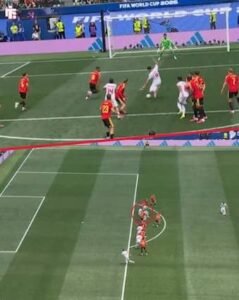
With this goal ruled out, Iran/Belgium was a draw. A win for Iran – a significant accomplishment in itself against high-level European opposition – would’ve had them poised for progression into the knockout stages of the tournament.
Instead the Iranians had to win their third and final group game, against Egypt. Which they did… except, once again, the VAR wouldn’t allow it.
The game officially finished 1 – 1. But the Iranians scored a dramatic winning goal late in added time. They scored it, celebrated it… and then VAR instructed the referee that the goal should be disallowed for offside.
Even the commentators in the live broadcast I watched couldn’t see the supposed offside. Again, it was so marginal as to be pretty much nonexistent.
More suspiciously, the TV replays of the incident – meant to illustrate the offside – switched to the cartoony/AI graphics instead of showing us the actual real-life footage (which they were doing a lot in this tournament). It focuses in on the Iranian goalscorer and the nearest Egyptian defender to ostensibly illustrate the offside: but it doesn’t show the broader picture – which would’ve shown a different defender playing the goalscorer onside, because he was further down the line.
This omission in the replay/analysis seemed notable to me: as if they showed us what they wanted us to see and not what actually happened. But the real-time live footage makes it clear there’s a defender further down who’s playing the Iranians onside.
The thing is, even if this wasn’t a deliberate match-fixing operation in play, the supposed offside ruling was so marginal as to be pointless.
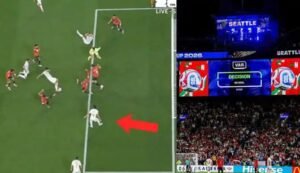
The result: Iran again fails to get the points to qualify for the next round.
Even after this, there was a chance of Iran getting through: but it required Austria v Algeria to be a decisive result and not a draw.
So, what happened in the Austria/Algeria game? The two teams played out a bizarre draw: 3 – 3, to be precise. Some of the goals were bizarrely easy to score. Both teams looked they weren’t really competing: it felt like a Sunday afternoon kickabout in the park.
Even comedian and former late night host Trevor Noah, whose livestreams during this World Cup have been great, noted with suspicion that Austria/Algeria was a very odd game featuring odd behaviour. At one point, when the Algerians score a third goal to go in front, the Austrian staff react strangely – as if they’re genuinely confused and angry as to why the Algerians had done that.
Did an Algerian player (Riad Mahrez, I think) go off-script by scoring a third goal?
The Austrians then naturally had to go get their third goal too – to make sure the game ended in a draw. So that Iran couldn’t progress to the next round?
If you think this is overly conspiratorial on my part, bear in mind that Austria is renowned for having done this kind of thing before: in the 1982 World Cup in a game referred to as the “Disgrace of Gijón”.
That Algeria/Austria fixture was full of odd behaviour, strange gestures and body language. Something was off.
The accusation then: Austria and Algeria drew on purpose, under instructions to make sure Iran didn’t progress in the tournament.
This being after, as discussed, Iran had already been denied two separate victories by VAR intervention: against Belgium, then against Egypt. Even one of those victories would’ve guaranteed them progression: both victories would’ve meant easy progression into the Round of 32.
The accusation: Iran beat both Belgium and Egypt, but the VAR was weaponised against them to deny both outcomes.
To a watchful eye, the reality seems to be that the Iranian football team could never be allowed to prosper in a tournament on American soil: while the US is actively at war in Iran. It was political.
I’ve never seen decisions so clearly measured to disadvantage a specific team in consecutive games. The aforementioned Austria/Algeria game took things to a whole other level – if it was the case that they were instructed to draw that game (which it certainly looked like).
“A disaster World Cup” is what Iran’s star player Mehdi Taremi called it before Iran’s elimination. You have to feel sympathy for Taremi when you watch him in the interview below: he seems exhausted and exasperated.
There was almost the sense that Iran’s team wasted their time even showing up for the tournament.
Days after Iran’s elimination, the US resumed bombing – abandoning the ceasefire agreement that had previously been reached.
It was from this point on that I started observing the World Cup with a suspicious eye.
As it happened, the Iran controversies were just the beginning.
But it was only days after Iran’s elimination that the controversy over Trump and the overturned red card happened.
Specifically, the US president demanded that FIFA rescind the red card and suspension of a US player so that he could play in the knockout game against Belgium. FIFA, despite the request being unprecedented and entirely at odds with its own rules, did what Trump wanted and the suspension was overturned.
That act seemed to alert everyone to the corruption at play in this World Cup: the media paid significant attention to this controversy – yet still failed to pay any real attention to the questions about Iran’s games.
Still, Trump’s intervention set a new tone in the tournament. If people had been trying to put aside the spectre of FIFA corruption and just enjoy the football, this sideshow made it more difficult.
And it reinforced suspicions I had harboured earlier in the competition: specifically concerning the USA’s opening game against Paraguay.
In that opening march, the US team destroyed Paraguay, 4 – 1. At the time, I commented to a friend that it seemed odd the South American side lost so comprehensively. If you watched the actual game, the Paraguayans seemed oddly open, as if allowing the US team to have the freedom to flourish in front of their home crowd.
Bear in mind, this same Paraguay team then went on to defeat Germany, and to frustrate a far superior France team. The French team (favourites to win the tournament) would struggle to score against a dirty and aggressive Paraguay, only eventually winning via a late Mbappe penalty.
But this same Paraguay team conceded four goals to a USA team that was able to totally dominate in that opening match?
Was the Paraguay team asked to let the US beat them in that opening match? Because it would be good for the tournament – and for the US? This is what I suggested to my friend at the time.
But it wasn’t until a fortnight later that I genuinely started to believe something like that might’ve happened. Because when Paraguay played France, something very conspicuous happened.
A dirty, unsporting Paraguayan team subjected the French to one of the ugliest performances in recent memory: committing fouls all over the place, harassing and bullying players, and generally resorting to all kinds of dirty tricks. This included even deliberately messing up the penalty spot right before Mbappe’s penalty kick – which they did right in front of the referee.
Observers all noted the ugliness of the performance – and commentators expressed dismay that the referee didn’t take any action at all against Paraguayan players.
In fact, no Paraguayan player received any card. It was as though the officials were under instruction to let the Paraguayans get away with whatever they wanted.
Why would that be?
Well, I had already considered the possibility that the Paraguayans had agreed to let the US team comprehensively beat them two weeks earlier. So, were they offered a free pass after that, in exchange?
In other words, as a reward for cooperating, were they promised lenient refereeing? Freedom to play as dirty as they wanted, without consequence?
That’s the only explanation I can think of for why the officials completely ignored their antics against France: antics which multiple commentators aptly described as ‘disgusting’. Killian Mbappe himself seemed bemused by the Paraguayan behaviour and by the referee’s lack of intervention.
If that seems overly conspiratorial, remember – this is the same tournament in which the American President openly intervened to overturn an on-field decision.
To suggest other shenanigans were taking place isn’t so far-fetched. This is an age of maximum – and barely concealed – corruption, after all.
Also, it might be worth noting that Paraguay’s elimination of Germany from the tournament was significantly aided by a VAR intervention that ruled out a German winning goal that seemed fine. So maybe Paraguay was being well looked after by the FIFA officials.
Also, Trump’s intervention regarding Balogun’s suspension ended up hurting the US team rather than aiding it: they looked demoralised and dishevelled in the subsequent match against Belgium, in which they duly thrashed 4 – 1. Evidently, the controversy ended up undermining their campaign.
But now let’s come to the game that really destroyed my trust in the competition. Egypt v Argentina.
This was the point after which I was no longer able to enjoy the World Cup. While the later England/Argentina semi final was the last game I was genuinely still invested in, after Egypt/Argentina my enthusiasm was essentially gone.
This is a game that could be talked about for years to come. It certainly will be in Egypt.
And the great shame of it is that it would’ve been one of the greatest World Cup clashes of all time… were it not for the issues I’m about to highlight.
The Egyptians, led by their icon Mo Salah in what was likely his final World Cup campaign, were clear underdogs against the reigning world champions. But their performance was epic, bringing Argentina to the brink of elimination.
I’m not particularly someone who previously subscribed to the popular theory that Argentina receives favourable decisions in order to ease their path to victory. Even before the Egypt game, there were popular memes going around using terms like ‘VARgentina’ or joking that FIFA stood for ‘Fixing It For Argentina’.
But I thought they won the 2022 Qatar World Cup as, on the balance, one of the best teams in the tournament.
But this insane clash with Egypt in the Round of 16 changed my mind.
Officially, Argentina won that game: in the most dramatic way imaginable. Egypt was 2 – 0 up with barely ten minutes to go. Argentina, guided by Lionel Messi, managed an impossible comeback, scoring three goals to snatch victory (the last of these goals coming in added time, mere seconds before the end).
Examine the game more closely, however, and the argument can be very much made that Egypt won the game – or at least would’ve done, were it not for that dreaded VAR interventionism coming into play.
The Egyptians in fact had scored another goal (a brilliant move, converted by Zico), but it was disallowed by VAR – because of what was a super soft foul by an Egyptian player way back in the Egyptian half of the pitch. Here’s the goal below.
The alleged foul was so far back in the play that one ex-footballer remarked that any further back would’ve been in the time of Tutankhamun.
In other words, the VAR was so desperate to nullify the goal that it had to go further back in the play than was reasonable to find a potential offense. Multiple experts, including some ex-referees on social media noted that the goal should’ve stood.
The referee seemed to agree – until the VAR pushed him to reconsider.
The shirt tug in question is also the kind of innocuous action that is commonly let go by most referees. You see shirt pulling like that in most games, usually unpenalised. In fact, the Argentinian player who is supposedly fouled is literally trying to tug an Egyptian player’s shirt at the exact moment his own shirt is lightly pulled. So penalising the Egyptian player makes little sense.
The ITV match commentator inadvertently characterised the nature of the intervention when he said, “Pre VAR, we would’ve been celebrating one of the great moments in World Cup history...”
The same commentator remarked later, when Egypt managed another goal, that we were witnessing “a tectonic shift in world football“.
But it was a tectonic shift that wasn’t allowed to become reality. Not if it meant the reigning champions and their iconic superstar captain being eliminated from the tournament this early.
Had the disallowed goal stood, Egypt would’ve soon been 3 – 0 ahead. Could Argentina have come back from that?
Even if they could, it would’ve then been 3 – 3 after added time: and then the game would’ve been forced into extra time. But I think the psychological hurdle of overturning a 3 – 0 scoreline with ten minutes left on the clock would’ve actually been too difficult even for Argentina and Messi.
More importantly, however, is that Argentina’s winning goal – scored in the dying seconds of added time – shouldn’t have stood anyway.
The move that resulted in the goal began with not just a foul, but a double foul, at the other end of the pitch. Mo Salah is tripped in the Argentinian penalty area, and an accompanying Egyptian attacker has his shirt pulled to prevent him going for the ball… and then Argentina gets the ball, launches the counter attack and scores the winning goal.
Not only does the referee not disallow the goal, but the usually pedantic VAR doesn’t flag up the fouls for the referee to examine.
Two fouls on Egyptian players in the Argentinian penalty area – and no VAR check. And Argentina goes on to win the match, with only seconds remaining. You can see the foul on Salah in the footage below.
More to the point, the earlier Egyptian goal that was disallowed was disallowed for a light shirt tug in the other end of the pitch during the build up to the goal. This winning goal by Argentina featured the exact same alleged offense: a shirt tug on an Egyptian player during the build up to the move. Yet no VAR.
It was never more obvious that the VAR system was being used to manufacture desired outcomes. FIFA didn’t want Egypt to win.
The Egyptian goal was disallowed in order to give the Argentinians a better chance at a comeback. The Argentinian goal wasn’t disallowed because FIFA wanted Argentina to progress.
The real result should’ve been a 3 – 2 win for Egypt.
But if we allow for VAR, then it should’ve been 2 – 2, thus going into extra time.
Either way, the actual result was illegitimate. This was basically a form of match fixing: utilising VAR selectively to achieve the desired outcome.
No wonder the Egyptians would go on to file an official complaint, demanding an investigation. They were robbed of a historic victory.
None of this detracts from the impressiveness of the initial comeback by Argentina (to get to 2 – 2): just as would happen against England in the semi final, the Argentine ability to rescue themselves from the jaws of defeat is spectacular. Messi also scored a superb goal.
But they didn’t get through simply because of their doggedness and skilful effort: they got through because key decisions were applied to facilitate their positive outcome.
I was so perturbed by that match that I watched the whole thing twice to make sure I had seen what I had seen.
What’s striking is not just the absence of VAR to examine the build-up to that third Argentina goal: but even the broadcaster didn’t show replays or close-ups of the foul on Salah that started the move.
Football programming is usually obsessed with slow-motion replays and analysis – even of minor incidents. Yet in this incident – concerning the winning goal of the match – they strangely shied away from it.
A friend of mine had only watched the highlights programme and not the live match: I asked him what he thought of the foul on Salah. He said he didn’t see it in the highlights package. Which means the highlights programme edited out the fouls that led to the winning goal.
The edit simply cuts to the Argentinian attack and the winning goal: as if nothing significant had preceded it.
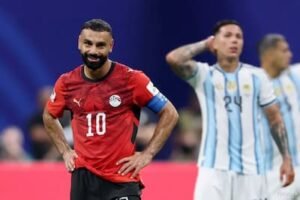
The image here, by the way, pretty much captures the moment Salah seems to realise something very dubious is occurring in this game and Egypt aren’t going to win.
What’s more, footage later uploaded online from inside the stadium showed more that was largely omitted from the TV broadcast: specifically, the Egyptian manager throwing up the ‘X’ sign with his arms – which is the FIFA signal for a racist incident having occurred.
It’s not clear what the Egypt manager was referring to, but the rule apparently is that the referee has to stop the game at that point to investigate what’s going on. Instead, the ref showed the manager a red card.
Now, sure, the Egyptian manager is known to be a volatile character, perhaps prone to antics. But it’s interesting that the TV broadcasters never properly showed what was happening over at the Egyptian bench.
They just referred to the referee issuing a card at the Egyptian staff, but didn’t elaborate on what had happened. Clearly, something was kicking off over there, with Salah also coming over, and Lionel Messi clearly approaching the Egyptian bench and watching something unfold.
Obviously, it started with the Egyptian protests over the Argentinian goal being allowed to stand and no VAR check being done regarding the fouls in the build-up. But then something else obviously unfolded: and the TV broadcasters decided not to point their cameras in that direction.
Mo Salah, being ever the polite and dignified type, didn’t engage in hysterics after the game. He simply said, “Everyone saw what happened. Every decision went against us“. The Liverpool legend later added, ‘We gave everything we had. But when the refereeing is constantly against you, it becomes impossible to compete…’
Egyptian goalscorer Zico, however, was more blunt in his comments after the match, as shown here.
The optics, even going into that match, were really bad: footage was circulated online showing Argentine fans being happily waved into the stadium in one line, while Egyptian fans were being patted down and searched in a separate line.
This vastly different treatment of the respective sets of fans turned out to be symbolic of what was also to happen on the pitch: with one team regarded as disposable in the tournament and the other team as superstars more entitled to progression.
After this match, I was convinced the competition was being fixed for Messi.
Now, let’s be clear about this: there’s only an extent to which you can rig the tournament. Mostly relying on marginal decisions and VAR. If, say, Argentina gets beaten 4 – 0, there’s not much you can do. But as long as it’s fine margins, you can make sure the key decisions go the way you want.
The Egypt/Argentina game ended up being fine margins: and so the outcome was able to be manipulated.
Similar manipulations were attempted in the final between Argentina and Spain, but were unable to be successfully executed: for reasons we’ll discuss shortly.
There were other instances of this in the tournament not involving Argentina. Senegal’s elimination by Belgium, for example, was decided by a late penalty that probably shouldn’t have been given: and after Senegal had been the far superior team.
But in most cases this is probably less a case of match fixing and more a case of VAR just being used very badly – which in itself has been a majorly noticeable issue throughout the tournament. In the superb Portugal/Croatia knockout game, for example, both teams had perfectly legitimate goals ruled out by VAR: Cristiano Ronaldo had a beautifully taken goal ruled out.
But in the case of Argentina, the argument is that FIFA, the tournament, the sponsors and corporate interests, all want the Argentines – specifically Messi, the greatest player in the world – to stay in the tournament as long as possible, and preferably to win it. Simply because it’s good business.
More Messi, more hype, more money.
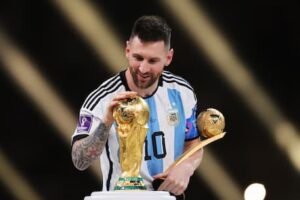
After all, Messi isn’t just a global icon, but the poster boy for US Major League Soccer. He’s essentially the Michael Jordan figure of the sport. So, naturally, it suits everyone – FIFA, the American hosts, the broadcasters, the sponsors – for the great icon to remain in the story as long as possible.
That makes sense. But it also renders most of the tournament – particularly in the later stages – suspect and thus lacking integrity.
The antics of the Argentinians in general only further exacerbates the bad vibes. Even before their nasty behaviour in the final against Spain, Argentine players were up to dirty tricks on the pitch in multiple games – and strangely not being punished for most of it by the officials.
Behaviour that would’ve seen other players from other nations get cards and warnings was largely let pass for Argentina players. This was evident in their semi final against England.
Even in the aforementioned Argentina/Egypt match, at one point an Argentine players casually slaps an Egyptian player in the face. It should’ve been a red card offense: but the referee doesn’t even caution him and the VAR is again strangely absent. Even the commentators in the TV broadcast don’t draw any attention to it.
None of this, by the way, is to detract from Messi himself, who is clearly one of the greatest players to ever play the game. He was superb in this tournament, even without the manipulations to aid his team. He was arguably the player of the tournament, even at the age of 39.
But there’s been a stench to this World Cup: and it’s largely because FIFA pushed too hard and was too obvious this time about its manipulation of the competition.
England’s dramatic semi final defeat to the Argentines was a straight loss with no discernible shenanigans: England basically threw the game away with bad tactics and a Messi masterclass got Argentina to the final.
In truth, I was so sceptical by this stage that I found myself wondering if England manager Thomas Tuchel had been asked to throw the game by FIFA (because England’s second-half tactics were so hopelessly self-defeating).
But no, that’s not what I actually think happened: England just got their game wrong and Argentina took full advantage. They were fantastic in that last ten minutes, actually.
The World Cup final, however, was an absolute stinker.
Argentina essentially didn’t play any football. They just resorted to their dirty tricks, aggression and manipulations all the way through – even after the match was finished.
And Argentine player got sent off this time: but only for an act of violence so obvious that the referee couldn’t really ignore it. The face that they were playing so dirty even in the final itself demonstrated how accustomed they’d become to favourable treatment and lenient refereeing.
In other words, because they’d been given a free pass throughout the tournament, they no longer expected to be scrutinised or penalised. The sense of entitlement also meant they simply couldn’t comprehend losing the final: and their behaviour showed it.
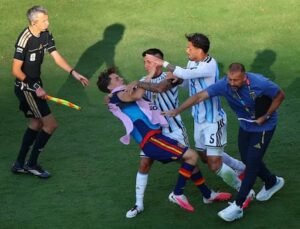
And, with the Egypt game still very much in my mind, it was evident that the FIFA officials were again doing everything they could to help Argentina. VAR was again utilised to try to determine outcomes.
It wasn’t enough though: even two disallowed Spanish goals (both of them seemingly legitimate goals) wasn’t enough to make Argentina win. Because the Argentinians didn’t even manage an attempt on goal until extra time. They were so bad that even the officials couldn’t manipulate the outcome – because the Argentines gave them nothing to work with.
Full credit to Spain for totally subduing the Argentinians the same way as they’d done with both France and Portugal.
But it was one of the worst games of football most people had ever seen. The Argentines acted like spoilt, entitled brats: the fact that, even as the game ended, Spanish players were literally being assaulted on the pitch said everything that needed to be said about the monster that FIFA had created in its favourable treatment of Argentina and its attempt to rig the competition.
In a tournament that had seen such classic clashes as England v Mexico, Croatia v Portugal, Senegal v Belgium, Morocco v Netherlands, Cape Verde v Argentina, and yes, even Argentina v Egypt for the sheer drama of it, to conclude this competition with such an ugly, dreary spectacle was a great stain.
But this was the result of FIFA’s machinations to get Messi and Argentina to the final: a total anti-climax that descended into the grotesque.
The final was actually somewhat reminiscent of the 1990 final between Argentina and Germany: in which an Argentina side led by Diego Maradona (in whose shadow Messi permanently exists) and who were the defending champions from 1986, failed to perform at all against an efficient German team.
Instead they resorted to dirty play and tantrums, with two players being sent off and Maradona in tears – just like Messi was on Sunday. A great tournament (Italia 90 is still my favourite World Cup, though probably for mostly nostalgia reasons) ended with a dull, ugly finale decided by one goal.

History repeats itself.
As noted earlier, we also need to touch on some of the politics with Argentina too.
As some have noted, FIFA’s favouritism with Argentina is especially interesting in the context of the Trump/Infantino relationship, Argentina’s Zionist president (the Trump clone, Javier Millei), and Argentina’s evident connections with Israel.
It’s curious that most of Israel appeared to be passionately rooting for Argentina. Rabbi Shmuley was beside himself when they lost the final. Israeli flags were seen at some Argentina games, including the Egypt match. Israelis were in the streets, watching Argentina.
Interestingly, Benjamin Netanyahu made it a point to announce his support for Argentina in the tournament. And Israel’s foreign minister Gideon Sa’ar openly taunted England after their defeat to the Argentines in the semi final. War criminals Ben Gvir, Smotrich and others also joined in.
Ben-Gvir actually shared a picture of Milei and Lionel Messi at the Western Wall in Jerusalem, saying “We will love those who love Israel. Let’s go, Argentina.”
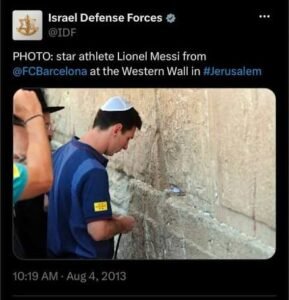
Why were Israeli officials making such a public point of showing their support for Argentina?
It sort of makes sense, given Argentina’s own dubious history with racial issues. Argentina is itself an Israel-like Colonialist project populated by strategic immigration by European settlers and the suppression of its black population. So solidarity between Argentina and Israel makes some sense, as Argentina is sort of a successful version of what Israel wants to be.
Some have pointed to the recently signed Isaac Accords between the two countries as explaining Israeli passion for Argentina. But actually the relationship goes back further than that: Israel, for example, supplied weapons to the Argentines in the 1982 Falklands War against England.
Older images of Messi at the Wailing Wall in Jerusalem were circulating online too: which is maybe a tad unfair, as other big-name footballers have also done the obedience trip to the Jerusalem wall too, including the likes of Brazilian stars like Neymar and Ronaldinho. And David Beckham appears to have strong ties to Israel as well.
Also, in fairness, Messi’s 2013 visit was with the entire Barcelona team in an organised event, not something he did on his own initiative.
Though it has to be said, Messi has made at least four trips to Israel. That’s his business: and it takes nothing away from his irrefutable skill as a footballer. But it is a curiosity.
Argentina’s president Milei – a zealous Trump/Netanyahu ally – is also moving the Argentine embassy to Jerusalem.
There’s something strange going on with Argentina. Peter Thiel just moved there too with his family: supposedly due to his alignment with the current Argentine government, though some speculate there may be something odder going on.
And Elon Musk has established a deep alliance with Milei too. Remember the embarrassing spectacle of Musk and the chainsaw, which was handed to him by Milei at CPAC?
At any rate, it’s easy to see why the football controversies surrounding Argentina took on significant political and cultural dimensions for some.
The fact that Spain’s super talented young star, Lamine Yamal, was seen brandishing a Palestinian flag at one point, shows how politics, world events and the World Cup very much overlapped at times. That might’ve been even more evident when Argentine players were holding signs about the Falkland Islands after the game against England.
In fact, in Gaza, Palestinians were cheering on Spain in the final, and especially cheering on Egypt in that extraordinary clash with Argentina. The fact that Palestinian football enthusiasts, after everything else those people are being subjected to, had to watch Egypt cheated out of their win by FIFA for the sake of Israel’s chosen champions is another sad dimension to the whole thing.
The Guardian had a stirring feature, showing images of Palestinians gathered to watch the World Cup games amid the rubble and ruin in Gaza. This image in particular of Gazans gathered to watch the Egypt v Argentina match really captures something that’s hard to describe.
The screenings in Gaza had been arranged by Mohamed al-Wahidi, director of public relations for the Egyptian Committee in Gaza. He was murdered by an Israeli missile while on his way to one of the screenings. Why they targeted him is unclear: demoralisation, maybe.
But the point is, you can’t really separate the political elements to the biggest sports event on the planet. The Iranian team found that out early.
It’s hard then not to wonder what the relationship is between Infantino/FIFA, Trump, Israel, Argentina, and the special way the Argentines were treated in this World Cup.
It’s not the first time the World Cup has been (allegedly) manipulated for political reasons: for example, the 1978 World Cup, won by Argentina, has long been the subject of rigging allegations. That World Cup in fact took place in Argentina, hosted by the right-wing military dictatorship.
The tournament being played there, and the Argentina victory, was seen by many as FIFA collaborating with the regime to validate the dictatorship.
There’s a sordid history to some of these tournaments.
In the end, it’s hard to say how the 2026 World Cup will even be remembered. For a lot of people, it will be for its awful climax.
For many it will be the dubious decisions, ugly antics and often bald-faced corruption.
It also depends who you ask. Ask an Egyptian. Or an Iranian. Ask an Argentine. Ask someone from Cape Verde. You’ll get different answers.
Really, the sometimes odd, sometimes unedifying, elements of the tournament, and the sometimes obvious signs of manipulation and rigging, are a perfect reflection of the broader world and climate that the World Cup took place in.
An event that began with people from ‘smaller’ nations being denied entry to the US, and with unpleasant spectacles such as the Senegal squad being subjected to public manhandling and searches when arriving in the US.
An event that most ordinary people were priced out of, where only the well-off could really be in attendance, and where cameras constantly tried to show us what celebrities or elites were present just to be seen.
The embarrassing Superbowlification of the final – in which football fans were interrupted by half an hour of Madonna, Justin Bieber and other tedious celebrities – somewhat embodied the whole thing.
As befitting a tournament taking place primarily in Trump’s America and under the control of someone like Gianni Infantino, it was always going to be inherently controversial and corrupted: even if often highly entertaining.
But it was the footballers who made it entertaining, and sometimes the fans: almost in spite of the organisers and institutions running these things.

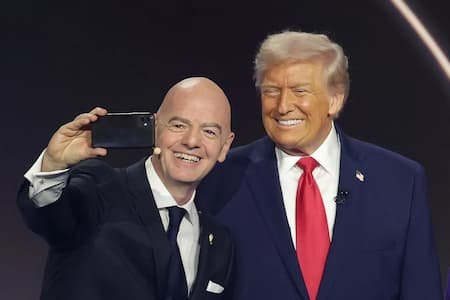
Argentina’s thuggish behaviour in the final, and the spectacle of Donald Trump refusing to get out of the shot as the Spanish players were trying to lift the trophy, pretty much summed up the entire unedifying undercurrent to this World Cup.
Yet, for all of that, it was still mostly entertaining and exciting, and still held the attention of billions of viewers worldwide while making billions of dollars ($19 billion, reportedly).
So FIFA still wins. And we’re not likely to see any boycotts for future competitions: just as we didn’t see any for this one.
So I guess everything just rolls on, as is.
At least it was in the best interests of the sport itself that Spain managed to win the final: and indeed managed to make the Argentinians look absolutely third rate and completely impotent. As for Messi, he probably should’ve retired after winning the previous World Cup in Qatar: and ended his saga on a super high.
Maybe the next World Cup, to be jointly hosted by Morocco, Spain and Portugal, will be a cleaner affair. Though if Infantino is still running FIFA, then we probably shouldn’t hold our breath.





Sadly, yes. It was a curse passed down to me on the paternal side of the family. In fact my whole family are Wolves fans – for a time I used to go to games with my mum, sister and nephew (the latest victim). You are teasing me with the ex-player. Obviously I’d love to know but can’t expect you to out him.
Well, football is often a matter of opinion – which is one reason we love it. In general I perhaps look at it differently and if there’s a disallowed goal and then shortly after the team scores anyway, I just see that as justice. Don’t know if you’ve played much yourself, but ‘goals change games’ (as someone famous used to say a lot – Alan Hansen?) Cliche but true. That’s my only point really. And Egypt’s second goal – when it came – did actually spark the Argentine reaction. But I’m protesting too much and to reiterate: a lot of this is opinion. What isn’t opinion is that FIFA is totally corrupt and VAR helps with the corruption – that’s the only good thing about being relegated in fact: no VAR in the Championship.
I attach the link to the article below – it runs through the likely reasons for the FBI coup, the Clintons and Platini and son involvement with Qatar, and the prior corruption when the Euros were hosted by Poland-Ukraine (if I remember correctly): https://wallofcontroversy.wordpress.com/2015/06/05/fifa-is-patently-corrupt-but-whats-this-fbi-sting-really-been-about/
Thanks for the link. I’ll tell you about the Wolves player privately.
I seriously intended to boycott this World Cup but in the end I watched almost as many games as I usually would and there were some classics as you listed them – also the Bronze Final was a fine example of how football can be played both on and off the pitch (the final scenes of the English and French players together genuinely made me proud). Regarding the specific points. I agree about Iran 100%. Everything about the way they were treated was absolutely disgusted and then they were robbed by VAR without any doubt whatsoever. Did Austria conspire with Algeria? Not so sure but then I have a dog in that fight because the last minute equalising goal was scored by Sasa Kalajdzic who plays for Wolves (and I like). So can’t really be impartial on that one!
The run of Argentina is more interesting. They definitely got preferential treatment but that’s probably mostly because of Messi. FIFA reliably aids the superstar players and also host nations in tournaments. Messi himself should have been sent off in their first match for a completely uncharacteristic studs down the calf challenge. Of course, that was never going to happen and there wasn’t even a review. The first Egyptian goal was magnificent and for the VAR to overrule it was a crime against the beautiful game. That said, I doubt it changed the result because Zico scored anyway soon afterwards and then Egypt went two up. That was when Argentina finally kicked into life and scored three goals. Basically Egypt fell apart and I think the likelihood is they would have done even if the first goal had stood (as it should have done). But in football goals change games and so the fact they got 2-0 up anyway makes me think the decision didn’t affect the outcome – what did was Egypt falling apart, as did England in the semi. As for the foul on Salah, I’m not convinced it’s a penalty. Had the situation been reversed however and that was Messi going down I have no doubt that VAR would have given it. VAR is as corrupt as hell. I hate it – always have done (because of how it affected Wolves a few seasons ago when we actually voted to ditch it but every other EPL club including Forest voted to keep it – another story).
The relationship between Infantino and Trump is totally disgusting of course and it all goes back to the FBI coup orchestrated using RICO anti-Mafia laws that took down Blatter. I wrote an extended piece all about it along with the Clinton’s role in Qatar’s successful bid to host it, Platini’s involvement in that and in the massive corruption surrounding the Poland-Ukraine Euros, as well as how this takedown happened right as a vote was taking place on the banning Israel because of their abuse of Palestinian players. Anyway, I am still amazed how many liberals like Gary Lineker cheered it on the lawfare. Useful idiots who as usual have never admitted they were duped.
The dire final was Trump-Infantino’s just desserts. Awful and embarrassing from start to finish. As you probably know, I like Messi but when he was desperately trying to get Cucurella sent off just for covering his mouth he hit an all-time low point. Such a shame his international career has probably ended with that debacle. And now I hate Argentina (the football team), which is something I didn’t. Without Di Maria and Messi they have been reduced to nothing but a bunch of loathsome entitled scumbags. (Good to get these things off your chest!)
So that’s my two cents. And now it’s back to watching Championship football…
On a more personal note, I’m very sorry to hear about the loss of your friend. Hope you’re well and thanks as always for another thoughtful and well argued piece – on a subject I actually think I can match you on!
Are you a Wolves fan? Funny enough, a former Wolves player from the 90s is actually a big supporter and friend of this site, all the way back from the ‘bedlam’ days. He also played for Millwall and a few other clubs, including under Graham Taylor I think. He’s a great guy.
Anyway, thanks for contributing to this subject. I disagree about Egypt: I think at 3 goals ahead, they would’ve had it sealed. And even if the challenge on Salah isn’t a foul, your point that if the same tackle had been made on Messi it would’ve been a penalty is precisely the issue.
But I’m glad we’re in agreement on the broader points about this tournament, especially the deviousness of VAR. And also the third place match: which just demonstrated how much better England can perform when the scrutiny, pressure and anxiety isn’t there anymore.
James, share the link here to your article about the FBI, Blatter, FIFA, etc. I don’t think I read that one.