WandaVision really is a masterpiece. And I don’t throw that word around lightly.
I always loved it, but ahead of the approaching VisionQuest series on Disney+ (a WandaVision sequel four years too late), I recently did a rewatch after four years and it reaffirmed how much I adore this show.
It also reaffirmed that this was peak Marvel storytelling that hasn’t been matched since.
I had wondered if, four years on and minus all the week-to-week speculation, online hype and water cooler moments, the show would have lost some of its excitement or some of its shine.
And yes, obviously it’s not as exciting as watching it live and waiting a week for each new episode. But the passage of time also enables you to watch with fresh and more objective eyes – and as a more complete entity.
Not only is WandaVision great both conceptually and in execution, but the scripts are fantastic, the performances are marvellous, and the whole thing is stylistically magnificent.
Just stylistically alone, this series is arguably the most creative, compelling and interesting thing the MCU has ever done.
Every element – from the shifts in eras each episode and the changing theme songs to match (Kristen Anderson-Lopez and Robert Lopez deserve so much praise for the show’s deft musical elements, as do Alex Kovacs and Michael Paraskevas: Christophe Beck‘s main score is also superb), to wardrobe, colour palette, and design, and to even the title of the series itself – is immaculately thought out.
The attention to detail is off the charts.
I mean just the title alone works on multiple levels: ‘WandaVision’ as in Wanda and Vision. Also as in ‘television’, with this series being part homage to eras of American television. And ‘WandaVision’ as in Wanda’s vision, because that’s what we’re experiencing.
The nuances, smart touches, aesthetic choices, musical flourishes, all of it, from the macro to the micro levels are so well considered – and are something you really pick up on more and more with repeat viewings.
It’s a level of depth that’s so rare.
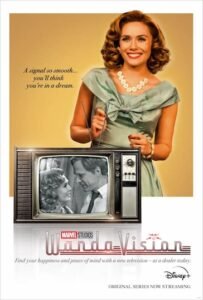
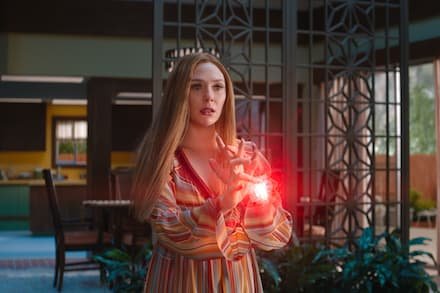
The performances are also very special. Elisabeth Olsen‘s performance is an absolute powerhouse throughout. I’d go as far to cite is as the most memorable, nuanced and overall superb acting performance in any Marvel project.
It’s such a full and complete performance from beginning to end, culminating in high emotional resonance. She does the quirky, comedic material perfectly, but then also really illuminates the more serious dramatic material towards the end, imbuing it with so much feeling.
Considering that, firstly, I didn’t like Olsen’s character or performance in the movies (until Infinity War), and considering also that, unlike with Vision, I’ve never been a big fan of the Scarlet Witch in the comic books, the fact that this portrayal of Wanda Maximoff is so compelling here is really something.
How much of that should be credited to the writing and how much to Olsen isn’t clear – probably a perfect marriage of both. Or maybe it’s that Olsen was given so much to work with here – and this is what she always could’ve brought to the role if she’d been more than a bit player in the films.
No matter: this project was clearly Olsen’s and Bettany’s reward – their time to finally take center stage.
Paul Bettany is also great as Vision, as ever – a persona he had already mastered in the MCU. And Kathryn Hahn‘s portrayal of Agatha Harkness is its own masterclass: played with so much fun and mischief that it’s hard to even think of her as the villain of the piece (if she even is the villain – some would argue it’s Wanda herself).
In terms of the writing, this series hooks you in to its mystery in the first few episodes: but how it manages to sustain the intrigue and fascination across nine installments without ever losing steam is a masterclass in both writing and pacing.
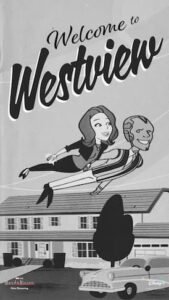
Those first few episodes really do hit perfectly: establishing the exact right amount of mystery and intrigue, while also being stylistically fascinating and doing the nostalgia concept immaculately (during the initial airing, I literally started rewatching old I Love Lucy and Bewitched episodes in-between WandaVision streaming dates).
When answers do eventually come, they’re so powerfully delivered and so emotionally engaging, even as the nature of the story and the stakes are mutating. Episodes 7 and 8 are heavy hitters: and are also where Elisabeth Olsen really peaks.
Nothing is underwhelming. Nothing fails to work.
Some have argued the finale is a little disappointing: but after all the intrigue and mystery, all the build up and speculation, it was always going to be difficult to find a perfect endpoint.
What that finale does offer, aside from visual spectacle, is a compelling conflict and an emotionally satisfying conclusion that resonates with everything that came before it – which is really what’s most essential in a climax.
On repeated viewings, this finale feels less and less problematic: more and more fitting. The emotional beats all land, the action is visually compelling, and it really feels like you’ve been on a long and engaging journey.
Speaking of the visuals, this series’ aesthetic shifts are so striking and so absorbing that you can almost just watch it as visual art and not even storytelling. The use of vivid colour and contrast throughout is always noticeable. It often feels like some vast art project.
The deft directing and the staging and camera work is immaculate throughout.
And there are some particularly memorable visual moments: chief among them the stunning Wizard-of-Oz style transition from black-and-white to colour that occurs at the end of episode two.
But even when the series goes into colour, the colours never quite feel real-world: they’re always a little too vivid, a little too idyllic. Which helps maintain the uneasy sense of unreality that the story requires – another example of this show’s immaculately clever details and design.
The retro stylings and aesthetics are also perfectly achieved for each change in era. Really, the production design for this whole series is on another level.
The decidedly clichéd tone of idyllic, nostalgic Americana that characterises the first group of episodes helps maintain the uncomfortable surrealism: all along accompanied by the niggling feeling of instability – the sense that this picture-perfect dream world is inevitably going to collapse in on itself from its inauthenticity and unstable foundation.
We are essentially inhabiting an unsustainable reality being maintained by an unstable, traumatized mind.
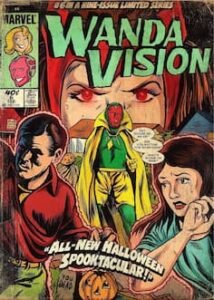
It did remind me a bit of the already-classic The Visions comic book mini-series from several years ago, which I also loved. That comic was one of the stated inspirations for WandaVision. But unlike House of M or some of the other stated influences, I was fully versed in that book.
In the end, this is of course a story about trauma and loss, and about what a desperate human psyche can do in order to cope with reality. A narrative that is embodied remarkably by Olsen’s incredible acting.
My mother got that underlying theme earlier than I expected her to when I showed her this series. The fact that she loved this show, even though the only MCU thing she’d ever seen before this was the first Iron Man movie, really demonstrates how layered this show is and how many levels it works on.
Literally all I did was give her a quick summary of Wanda and Vision’s backstory and the fact that Vision was dead: but she was hooked on the show from start to finish.
I could go on and on, listing all the things that are great in this show, all the reasons it’s so good. I could list countless specific plot twists or reveals, acting nuances, brilliant musical flourishes, perfect fourth-wall breaks, or genius juxtapositions.
But then this would turn into an essay.
But the more time passes, the more I’m amazed that a series like this even existed: a show with such an odd premise, so conceptually awkward, and which was such a tonal departure from anything that had existed in this property beforehand.
The idea that Marvel’s first venture into streaming would be a quirky, offbeat love story wrapped in a mystery play, itself framed within a concept-driven homage to the various decades of American television… well, it would’ve sounded unworkable, even doomed to failure.
The fact that they pulled it off so beautifully continues to surprise me even now.
Matt Shakman and Jac Schaeffer, and co did an incredible job.
A few years on, and having just recently been bored to death by increasingly dull and perfunctory Marvel shows like Daredevil and Ironheart, WandaVision already feels like something from an older time: something that was inspired and was clearly made with a great deal of love and care.
WandaVision genuinely might be my all-time favourite MCU entity. It’s hard to say, as the MCU is so vast and there’s lots that I’ve liked. But I think it might be in my top five all-time TV shows in general. That’s how highly I rate this show.
I still suspect nothing as good, nothing as emotionally resonant, or as conceptually interesting, will be produced by the MCU again. I wish they’d attempt more ambitious, interesting material like this more often, instead of falling back on more obvious, textbook tropes.
But that WandaVision even happened and even exists is good enough for me: because it feels like something of a miracle.
And this is a show I know I’ll be revisiting every few years.