‘With the first link, the chain is forged. The first speech censored, the first thought forbidden, the first freedom denied… chains us all irrevocably…’
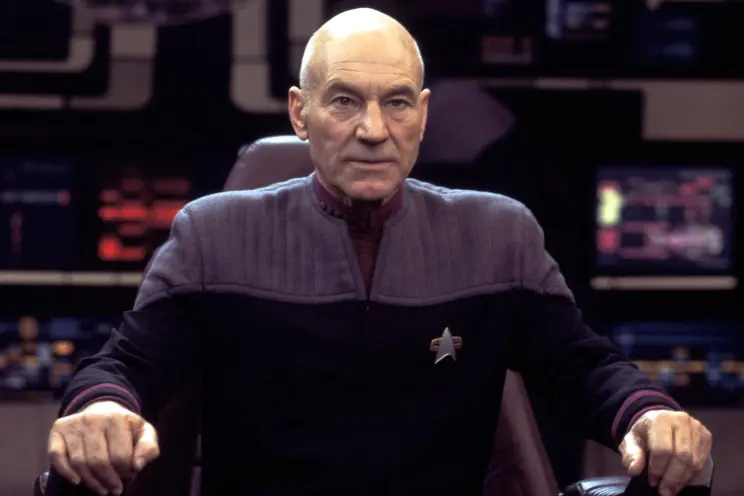
So said Captain Jean-Luc Picard, in the classic Star Trek episode ‘The Drumhead’.
He continued, with that typical Picard gravitas, ‘The first time any man’s freedom is trodden on, we’re all damaged.’
It’s dialogue like that, so relevant in any era – and delivered so potently by such a unique actor – that I most associate with both Patrick Stewart and his most famous onscreen persona.
I never saw Patrick Stewart on the stage that he was such a master of (though one of my friends once begged me to go see him and Ian McKellen in Waiting for Godot and I was sadly unable to go).
So my relationship with the iconic, bald-headed thespian master (and ever-proud Yorkshireman from a working-class childhood) has been entirely via television and film.
And he has been a major fixture in that regard for most of my life: as he has been for most people my age. By the way, if you’ve never seen Patrick as Vladimir Lenin, you should look for it.
I’ll talk about Star Trek here, obviously: and the abiding significance of Picard to people in my generation.
But, as ubiquitous as Star Trek and Jean-Luc Picard have always been in my life, I actually embraced him just much as the wheelchair-bound Professor X in the X-Men movies. He was absolutely born to play that particular role.
No one else on earth could’ve played that part: and he did it so well, imbuing Charles Xavier with such perfect gentility, compassion and fatherly gravitas.
Even when I was reading X-Men comics as a kid in the early nineties, I used to imagine an older Patrick Stewart as the bald-headed man in the wheelchair – and this was years before he was actually cast in the role.
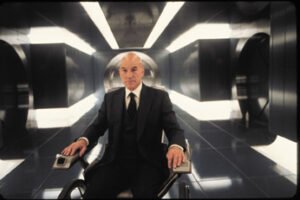
That’s no doubt why he’s been called back to that role so often: including in the upcoming Avengers: Doomsday mega event movie, which will now act as his last hurrah.
I remember being a bit sceptical about translating X-Men to the cinema back in 2000: but the moment I saw Patrick Stewart on-screen in the wheelchair, I relaxed in my cinema seat, assured that this was going to work.
And it did. But this was in an era where comic-book movies weren’t yet as prominent or assured: and having Patrick Stewart and Ian McKellen in that first X-Men film is what made it work, affording the project an acting weight that it needed.
For some younger people, they don’t even know him as Captain Picard, but entirely as Professor X.
While I got a few messages from friends today about Patrick Stewart passing away, I actually got back-and-forth texts from my younger sisters on the matter too – and they’ve never been Star Trek fans in the least bit. Which shows how much of a general presence Stewart is, even irrespective of his most famous role.
One of the exchanges I had today was with a friend who, as long as I’ve known him (since we were teenagers), has pretty much adored Patrick Stewart and Jean-Luc Picard as probably his number one TV/film icon. Many feel the same way.
But as big a fixture as Star Trek has been in my life, I was actually never a huge Picard fan necessarily: I was more a Captain Kirk guy (and later more of a Sisko fan). But there’s no questioning the singular weight and gravitas Patrick Stewart brought to that role for so long.
And no question about the ubiquitousness of Picard and Sir Patrick in the collective landscape for people growing up in the eighties and nineties. TNG was everything: especially in those dry years of the late eighties and early nineties when science fiction on television essentially didn’t exist.
Patrick Stewart was actually a very strange – and ultimately very clever – casting choice for the new Captain of the Enterprise for the new era. He was nothing like Shatner’s iconic, swashbuckling Captain Kirk. It was a character – and an actor – cut from a completely different cloth.
But it ultimately worked. Patrick Stewart’s portrayal brought something entirely new and different: despite some early naysayers. Proving that Gene Roddenberry, despite some opinions to the contrary, knew what he was doing.
His Shakespearean pedigree also was perfect for what was to be often a very cerebral, intellectually engaging series about not just exploration and science, but ethics, philosophy, culture and politics.
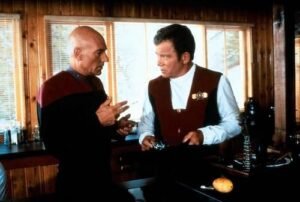
Picard’s refined, intellectual nature worked so perfectly in that context.
I, like a lot of people, learnt a lot of my early sense of ethics, moral issues and philosophy from Star Trek, and particularly from Picard: particularly due to what William Shatner noted today was the unique ‘humanity’ that Patrick Stewart brought to everything.
While the later TNG movies weren’t great (although Stewart gave his best performance as Picard in 1996’s First Contact) and I wasn’t a fan of the recent Picard streaming series (although the third season was somewhat better), the longevity of his onscreen legacy as the Captain of the Enterprise was already guaranteed long ago.
Like Shatner or Leonard Nimoy, for a great many people Patrick Stewart’s science fiction alter-ego has been as constant and familiar a presence as that of an actual family member.
I made a similar point when Leonard Nimoy died in 2014. Because of becoming inextricably linked to their iconic alter egos, we start to see them as immortals: but, in a very real way, that same relationship does in fact impart a manner of immortality.
That’s the benefit of being lucky enough to land a role as significant as that one was (a role that Ian McKellen had told him to turn down) – and being a good enough actor to make it work.
I didn’t want this to be entirely about Star Trek: but it’s hard not to be, when he was so identified with that world.
But I also want to mention that Sir Patrick also was my favourite ever performance of Ebeneezer Scrooge: in a made-for-TV version of a Christmas Carol in the late nineties. More so than Michael Caine or even Alistair Sim, Stewart’s embodiment of Scrooge in that largely forgotten production is the definitive one.
It’s a shame that that TV production hasn’t quite become a seasonal staple the way it deserves to be.
It’s an act of self-harm on my part that I didn’t see his famous one-man Christmas Carol stage show (where he played every character).
I also particularly remember him playing the role of Aelius Sejanus in what is probably my favourite television series of all time – the classic BBC production of I Claudius. He showed in that extraordinary series that he could play a horrible villain – although I most remember being shocked the first time I saw it by Patrick Stewart having hair.
For that matter, he was also a remarkable Vladimir Lenin in an old historical drama called The Fall of Eagles, which I only discovered and watched fairly recently.
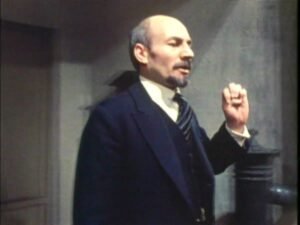
I believe the episodes are up on YouTube, if anyone wants to check those out. Honestly, if he was destined to embody Professor X, he was equally born to play Lenin. That’s a great TV series.
I had actually just been watching an old TNG episode a few hours prior to his passing being announced. As it happened, it was a Picard heavy episode (the excellent ‘Who Watches the Watchers?’).
While fans have obvious favourite Picard stories (‘The Inner Light’ and ‘Best of Both Worlds’ typically get mentioned), I think mine has always been the TNG series finale ‘All Good Things’: in which Picard’s consciousness is split between three time periods, including old age, as he stands cosmic trial for all of humanity and prove that humans are worthy of life.
But the TNG episodes ‘Darmok’ and ‘Tapestry’ are also right up there: the former being a highly regarded examination of language and culture clash, the latter being an exploration of how an entire life and character can be completely altered for the worse when unravelling a single undesirable thread from one’s youth.
These stories stay with you: and I keep going back to them, no matter how old they are now.
While, as I said, I was not a fan of the more recent Picard revival streaming series, it did at least give Stewart the chance to come back to that role one last time in older age. I may have to revisit that series and give it another chance, if only to appreciate his performance.
As I recall, in that series an elderly and ailing Picard does die – but has his consciousness transferred into an android body. Transhumanism, I guess. But I imagine those scenes might feel a little different to watch now.
Sir Patrick is also in the upcoming and hugely hyped Avengers: Doomsday as Professor X (releasing December 18th). It isn’t clear how big his role in it is, but he features in a dramatic moment in the trailer.
It may end up being his final onscreen appearance.
Which, in a way, would be unfortunate: in as much as I imagine he would prefer his last role to be something more singular and less franchisey.
But the truth is that, in the last couple of decades, his screen presence (outside of the theater stage) has been largely tied to those two iconic characters.
Which isn’t a bad thing at all. Most actors, one imagines, would kill to have embodied such lasting and wide reaching roles and for so long.
Even the most successful and lucrative box office movie stars won’t achieve that kind of longevity and relevance beyond their lifetimes.
I also feel bad not having had time to write anything about Walter Koenig, who famously played Pavel Chekhov in the original Star Trek, and who also passed away just a few days ago.
I could do a whole piece just on the boldness of Roddenberry placing a Russian on the bridge of the Enterprise at the height of the Cold War. But I haven’t had time. Koenig was also great playing a villain in the sci-fi epic Babylon 5 many years later.
He also made a timely cameo in the finale of the aforementioned Picard series a couple of years ago: which now feels especially fitting.
So, Rest in Peace, Walter Koenig.
And let’s raise our glasses once more to Sir Patrick Stewart. Farewell, Captain. It was a pleasure to voyage with you. And an education. I feel like there’s much more I want to say here, but I had to write this piece on short notice.
Maybe I’ll find some Earl Grey tea and drink a toast.
I’ll end with a quote right from the mouth of Jean-Luc Picard, from the classic Star Trek episode ‘The Inner Light’: ‘Live now; make now always the most precious time. Now will never come again…’