
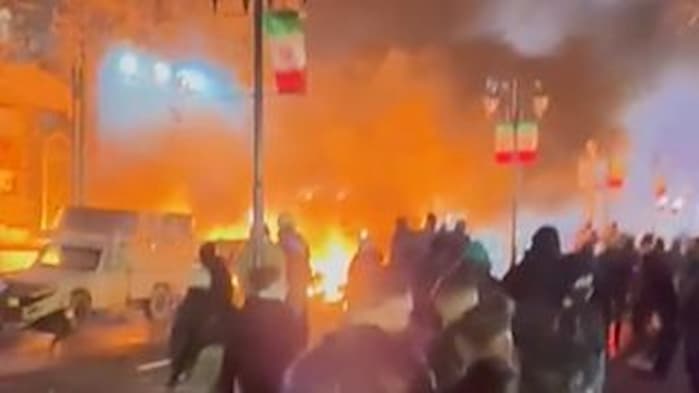
Some kind of US attack on Iran seems to be imminent.
Iran hasn’t been out of the news for weeks, since protests erupted and the resulting crackdown by the regime began.
But what exactly has been happening in Iran? How much of the narrative has been manipulated, and do we have any reliable, unbiased sense of the reality?
Are the protests dying down? To what extent were the protests hijacked by outside forces – or even guided from the outside? What do the protesters ultimately want? Why did President Trump vow to intervene in Iran if protesters were killed, but then decline to act when protesters were reportedly being killed in large numbers?
And where does the ousted Iranian monarchy and its heir fit in to the equation?
Well over 6,000 people have been reported killed so far, according one set of figures: another source puts the number at over 30,000. If true, that is of course appalling.
And this is a regime that has a poor track record in its response to protests. And the so-called Islamic Revolution in Iran has been violently suppressing opposition since the first days of its regime.
But, as ever, the reality on the ground might be more complicated than the overly simplified picture painted by foreign media entities.
For one thing, the wildly varying numbers being casually bounced around in the media are questionable. Uncertain sources are cited with little or no evidence or verification provided for the alleged number of dead. In some cases, the source is simply someone ‘with friends in Iran’ – as if that’s all the credibility required.
Robert Inkalesh, writing at The Cradle, does a good job assessing this problem of the alleged numbers of killed protesters. The basis for the media’s frequently cited numbers, as he illustrates, is definitely open to challenge.
Also, as highlighted weeks ago, the indications of Israeli involvement in the unrest were hardly being concealed, but in fact boasted about. The conspicuous ‘Mossad Farsi’ openly implied its presence in the protests, while some Israeli media acknowledged that Israeli operatives were active in Iran.
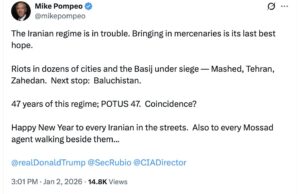
Most oddly, former CIA director and Trump administration official Mike Pompeo was either boasting about the Mossad presence or trolling the Iranians when he posted his Mossad tweet.
I’ve said many times that I personally have no love for the regime in Iran and would not feel sorry for its demise. But irrespective of that, and irrespective of whether the security forces have killed as many protesters as suggested, the way the protests have been covered in Western media has been questionable.
The narrative seemed way too neat and tidy from the start.
Essentially, evil regime murdering protesters; brave Iranians calling for revolution; brutal crackdown; and, most suspect of all, conveniently ready and eager replacement-leader being championed by some media outlets and their carefully selected Iranian voices.
The fact that this replacement leader happened to be Reza Pahlavi (pictured below), the son of the deposed Shah, is obviously no coincidence.
The Shah was the Western backed dictator/monarch that Britain and the US installed after staging a coup against Iran’s democratically elected leader Mohamed Mossadegh in the fifties (when he tried to nationalise Iran’s oil).
Are we really to believe that average Iranians want a return to monarchy? Is that what they’ve been in the streets protesting for? I thought it was about the economy?
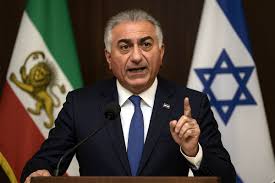
Who in Iran wants monarchy back? You know, the same monarchy they had the Iranian Revolution against in the first place – in 1979, before it was hijacked by the Ayatollahs and the religious extremists.
Iranian monarchists are a curiosity. They appear to be a small minority, but they show up in media interviews and sometimes in strange places – such as at Tommy Robinson events in the UK. I noted the presence of these monarchists at ‘Tommy’s’ London rally two years ago: but ‘Tommy’ also just recently started championing the Iranian protests, conducting interviews with British Iranians and even vowing to burn an image of the Ayatollah.
Nothing suspect about ‘Tommy’ showing an outsized interest in Iranian monarchy, no sir.
And here’s a video of ‘Tommy’ calling for Reza Pahlavi to be installed as leader in Iran. Although why the fuck anyone is interviewing ‘Tommy’ about grave geopolitical matters is beyond me.
And are there really Iranians calling for Trump to fulfil his promise and come to their aid with military intervention? I’ve seen this being implied in some media.
Moreover, Western coverage of these events predictably failed to mention the aforementioned Israeli involvement on the ground – despite Israeli media being open about it.
Nor was attention drawn to Israeli media reports suggesting that weapons had been supplied to Iranian regime-change protesters. According to the Times of Israel, ‘Channel 14, which is seen as close to Prime Minister Benjamin Netanyahu, said in an unsourced report Tuesday that “foreign actors” were arming anti-regime protesters in Iran. According to the network’s political correspondent, Tamir Morag, the weapons have enabled protesters to kill hundreds of Iranian security personnel…’
If weapons were being provided to protesters to escalate the conflict, then some of the harsh crackdown by the Iranian state forces would have to be viewed in a different context.
The fact that said protesters have in some cases behaved oddly – such as attacking mosques and religious buildings – also invites questions about what kind of ideologies or agendas are in play.
Which is not to excuse security forces from their violent or murderous excesses: but if they’re dealing with armed groups in some instances, you could see how that would turn violent.
It seems not too dissimilar to events in Libya in early 2011, where the foreign media was portraying regime forces using deadly force on ‘protesters’ – whereas the Libyan army was trying to explain that the deadly force was being used against armed insurgents who had launched coordinated attacks.
Elon Musk’s Starlink system was also employed to counter the regime’s Internet shutdown, with thousands of Starlink terminals smuggled into the country. This apparently was eventually neutralised by the Iranian state: but it shows again a coordinated outside effort (for good or bad) in play to facilitate the upheaval.
Coming back to the hovering figure of Reza Pahlavi, it should be no surprise that the heir to the Shah’s throne is a friend of Israel, with links to Netanyahu.
Pahlavi in fact was in Israel in 2023, visiting the Wailing Wall and having meetings with Netanyahu and Isaac Herzog.
@hananyanaftali I witnessed something extraordinary when Crown Prince Reza Pahlavi entered Jerusalem’s Western Wall – the birds started flying and sing, and there was a dove above his head as he was signing the guestbook and writing about the friendship between Israelis and Iranians. TRULY BIBLICAL! #RezaPahlavi #CyrusAccords #Iran #Israel
According to an Israeli Haaretz article from October, there has been a digital campaign being run from within Israel, aimed at Pahlavi being installed in Tehran: ‘…a large-scale digital influence campaign in Persian was underway, operated out of Israel and funded by a private entity that receives government support. The campaign promotes Pahlavi’s public image and amplifies calls for restoring the monarchy. The campaign relies on “avatars,” fake online personas posing as Iranian citizens on social media…’
‘According to five sources with direct knowledge of the project, native Persian speakers were recruited for the operation. According to the sources, the campaign included fake accounts on platforms such as X and Instagram and used artificial intelligence tools to help disseminate key narratives, craft its messages and generate content…’
So he’s obviously been groomed for this eventual regime change. Pahlavi has been living in the US, presumably waiting for his moment.
It reminds me of how the Libyan General Khalifa Haftar spent years living in Langley, Virginia, right next to CIA headquarters: and then in early 2011, when the uprising against Gaddafi was underway, he was simply dropped into Libya and announced by the US as ‘leader’ of the rebels.
Haftar, by the way, is now essentially a warlord, active not only in Libya but in the bloody civil war in Sudan, where his forces have been accused of massacres.
We could also note the more recent example of Venezuela’s exiled leader-in-waiting, Corina Machado, who’s links to Israel we covered here: and who has clearly been groomed as the Western establishment’s replacement for Maduro.
Whatever else might be going on in Iran, the insertion of Pahlavi into the desired regime change equation is clearly an Israeli project. If it is what ends up happening, it won’t be a ‘revolution’ at all, even if it’s sold that way: but rather a counter-revolution to restore the old order.
The 2011 Libyan catastrophe was likewise not a revolution as the propagandists claimed, but a counter-revolution against the original 1969 Green Revolution led by Gaddafi – in which a corrupt monarchy had been overthrown.
Sound familiar? It’s the same playbook. There’s nothing new under the sun, is there?
As much as they may want the current regime gone, it doesn’t seem likely, however, that ordinary Iranians would welcome the son of the Shah as the solution.
And the US and the West’s track record of trying to create functional democracy after Middle East regime change isn’t a good one either.
And let’s remember that Iran was a democracy – until Britain and the US killed that democracy in the 1950s and imposed the Shah’s dictatorship. So US or Western imposition of a new government in Iran would seem to be a terrible idea.
Needless to say, having Israel get to recreate Iran in its preferred image isn’t a viable solution either.
It’s difficult to see then what the best solution is for Iranians. Clearly the Islamic Revolution is on its last legs: and if the government really has killed as many protesters as has been suggested, then it’s surely lost any remaining legitimacy with the general population.
The only way this regime might temporarily survive is Trump: specifically that Trump is an unpredictable figure who doesn’t always strictly stick to the script.
Trump might stage some degree of attack but otherwise leave the regime in place, albeit in a further weakened state.
But even in that scenario, a regime collapse seems like an approaching inevitability.
Also, the sad truth is that the people risking everything for revolution are often betrayed or forgotten in the endgame.
The original 1979 revolution was led by all kinds of groups and activists, many of them secular and most of them striving for democracy. Instead what they got was ruthless, hard-line religious rule and more dictatorship.
Likewise, today’s activists and protesters might be taking all the risks and doing all the hard work, and putting their bodies on the line: but even if they succeed, they might find that it’s someone else’s will and agenda being enacted.




I will try again to post these links to pieces that I think do better on this topic in the hope that you may read or watch them and do better in future. Probably a forlorn hope on all counts but I tried.
Stop Waiting for the Iran War to Start – It Already Did
https://www.youtube.com/watch?v=_K0qOiHqiNU
https://www.middleeasteye.net/opinion/why-west-will-never-accept-iranian-sovereignty
https://www.middleeasteye.net/opinion/irans-battle-survival-arab-worlds-fight-too
Very kind words, thanks.
https://www.middleeasteye.net/opinion/irans-battle-survival-arab-worlds-fight-too
https://www.middleeasteye.net/opinion/why-west-will-never-accept-iranian-sovereignty
Stop Waiting for the Iran War to Start – It Already Did
https://www.youtube.com/watch?v=_K0qOiHqiNU