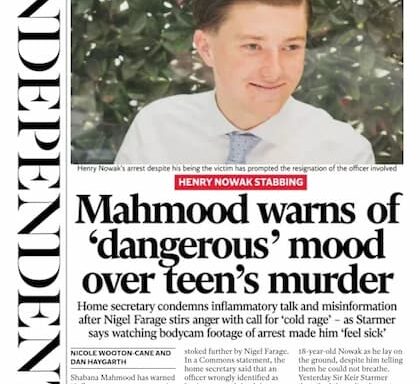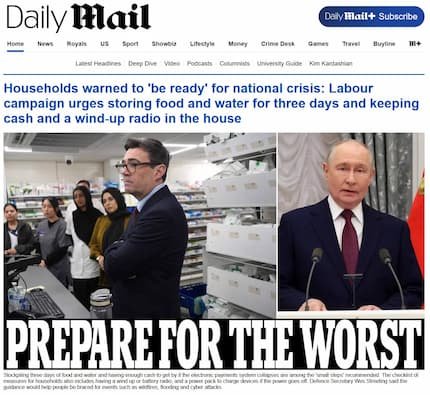
You might’ve noticed a number of news items about the government advising people to stock up on food and emergency supplies.
I noticed these warnings appearing in the headlines about a month ago; but they’ve reappeared more explicitly today as part of a government campaign called ‘Be Ready‘.
Whereas the previous advice, as far as I remember, was about stocking up on water, imperishable foods, medical supplies, etc, the guidance has expanded to include things like batteries, power banks, FM radios, and even physical cash.
The warnings are now becoming quite prominent in the UK, under the new banner of a ‘national resilience’ campaign.
What isn’t clear is specifically why.
Most of the news articles merely speculated on possible scenarios that might necessitate emergency preparedness. Interestingly, extreme weather scenarios were cited as one possible reason. The fact that we have a major storm hitting this weekend might explain the renewed warnings today.
And we’ve certainly had increasing extreme weather events across Europe.
But disruptions to national infrastructure were considered too. Some also strongly pushed the possibility of conflict escalation, predictably involving Russia. The talk is also more explicit now about ‘hostile states’ or terrorists being a likely source of the threat.
What was curious a month or so ago is that it was left to news outlets to speculate: instead of the government being specific about why it was putting out this advice. It seemed strange for the government to issue such guidance about stocking up on vital supplies (and potentially causing some anxiety) without giving a clear sense of what kind of crisis was being envisioned.
The Be Ready government website now does list possible crises to be worried about, but it’s still like a game of ‘pick your crisis’ from the options. It also offers a downloadable “Be Ready checklist”.
It is also being referred to as a three-year plan to increase national readiness and resilience.
And yes, it probably is just the government genuinely wanting to strengthen the nation’s preparedness for crisis situations.
But it’s also almost as if they’re trying to instill a vague sense of peril, creating some low-level tension and anxiety. The sense that something bad is possibly coming, but who knows what or when?
A major cyber attack, possibly involving hostile foreign actors?
An attack on the national grid has been suggested in some quarters too.
The noticeable thing that’s been ramped up lately in the national discourse as a possible source of threat is Russia and possibly Iran. And there’s been lots of talk about military preparedness and the possibility of war.
Here’s the army chief, for example, talking somewhat ominously about the need for war preparedness: ‘…Very soon, the political leaders of this country will start to have a frank conversation with the citizens of this country about just what is going on and where the risk lies… They are going to try and explain to our citizens that our citizens have got to consent to sacrifices to prioritise defence and security.’
There’s been a string of such comments or op-eds from military people talking about the need to prepare for war or putting Britain on a war footing. It’s getting a bit worrying.
But how much of this is scaremongering? Or how much of it is acclimatising the population to possibilities it has no appetite for?
Is all the war talk from military people realistic? Or is it a psychological programme?
The government website says this preparedness plan is bringing the UK into alignment with other European countries that are already in this mentality.
We’re told the ‘Be Ready’ campaign will pop up in various forms around the country, in social media feeds and on radio adverts, over the next three years.
So this is going to be a continual discussion or backdrop now: a constant sense of imminent danger and the need to ‘be ready’.
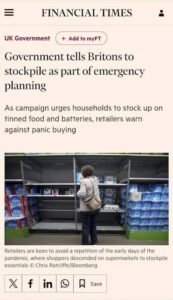
Emergency preparedness is obviously a good thing: but are people being put into an unnecessary anxiety mode?
Again, either the government genuinely sees a crisis – or combination of crises – coming and wants the population to be prepared: or it is trying to encourage a sense of ill-defined anxiety for some reason.
If it’s the former, surely they’d be better served to be more specific and less vague?
Some might think back to the old Cold War days and the famous warnings and guidances concerning what to do in the event of nuclear attack. But again, at least that was more explicit about what the threat was – rather than an ambiguous warning for people to be prepared for… what, ‘select crisis from list provided’?
It’s almost ironic though that all those classic ‘preppers’ – long mocked as paranoid conspiracists – are now being somewhat vindicated by actual government guidance.
I’ve known a couple of people who’ve been in emergency prepper mode for years already: fully stocked up on vital supplies and survival gear in expectation of some looming catastrophe. Their ideas of what kind of terrible event was imminent are probably more dramatic than anything the government will be explicit about: but nevertheless, they’re sort of being vindicated by this climate.
One of them used to chastise me for not taking the whole ‘doomsday prepping’ seriously enough. ‘I have some cans of tuna’, I used to tell him. He’s going to be insufferable if this kind of climate continues.
Online prepper stores might see a boost in business from all this emergency talk though. None of those survival kits are cheap though.
The problem with government discourse like this is that it does create tension and invite speculation and fear. But we just went through the whole COVID business only a few years ago and we’ve seen how quickly an alien state of affairs can be triggered.
One also can’t help but wonder about all those billionaires and tech moguls building their underground bunkers and emergency shelters (as I explored here, including President Trump and his fake ‘ballroom’): and to again ask, ‘What do they know?’
Because, clearly, those elites think something’s coming (‘The Event’ was the term being circulated) – something that they either want to prepare for or that they’re complicit in themselves.
At any rate, this preparedness programming is due to escalate over three years, so it’ll be interesting to see how the advice evolves and whether a more specific crisis or threat becomes more evident.
You know what though? It’s nice to see physical cash being mentioned as a necessity again. Maybe we’re realising that the full-on digitisation of money is a bad idea, after all. A silver lining, maybe? More of a return to older, analog technology and lifestyle might also be more of a discussion: there’s talk already of the importance of analog radio, for example, after years of wanting it to be phased out.
To me, that’s not a bad thing. The blind rush to make absolutely everything dependent on the Internet (much like the current steamrolling ahead with AI) always seemed very short-sighted, creating an unnecessary degree of vulnerability. I’ve often wondered if we actually *need* a decent cyber attack to make us rethink our whole system.
As for the emergency stockpiling, is there going to be a rush to purchase essentials? The kind of toilet paper rush we saw during the COVID days, for example? Hopefully not.
Also, not everyone can afford to pay for extra supplies. Or to fork out for special radios or portable power units and the like. There’s a cost of living crisis, after all.
So, for a lot of people there’ll be the anxiety but not the means to do anything about it. That’s a shitty state of mind to be put in to.