
Admittedly a strange one, this.
I almost wasn’t going to post it at all: but I’ve decided to just do it anyway. I apologise in advance if this article slightly lacks clarity: I haven’t thought it through very well.
Apologies also for the lack of new content here recently. I’ve been struggling with some difficulties on various fronts, making it hard to do business as usual.
I’ll just plough on with this one though.
So let me start here: the sudden, and possibly strange, death of US Senator Lindsey Graham on July 11th was met with a fairly predictable response by the majority of people online.
Which is to say, no one was sad to see the war-hawk and overall psychopath gone.
I’ll touch on possible conspiratorial elements to his death at the end too.
But the fact that rather pronounced and protracted funeral proceedings were planned for him, including horse-drawn caisson and military jet flyover, and in which he was excessively praised and celebrated, demonstrates the vast disconnect that exists between public feeling and soulless establishment theater.
But I’ve been thinking a lot about death in general lately, and about human beings. Two days before the news broke about Graham’s death, I lost someone very close to me.
On July 9th, after a very abrupt illness and very rapid deterioration, my Uncle James (who I lived with for over twenty years) was taken off life support. Don’t worry, this isn’t going to turn into a eulogy for my Uncle: but it just got me thinking about how different human beings are to one another.
My Uncle was a simple, down to earth sort of guy. He scraped by all his life, just about managing. But he was one of the most upbeat, polite, friendly and humble people you could ever meet. Could never hurt a fly. Never engaged in negative interactions.
Always remained positive, even when I thought pessimism was more appropriate.
Completely non-political, totally unjaded about life. He was actually so upbeat that I sometimes found it odd: making me really realise how distinctly not upbeat I am.
And how cynical I am compared to someone like him, even though he was over two decades older than me. I once jokingly likened him to Ned Flanders from The Simpsons (minus the religiousness).
And his positivity wasn’t because of a naive or protected life: far from it. For example, my Uncle spent time in a prison cell for a crime he didn’t commit (and was eventually completely cleared of). And this was because his own employers recommended him to police as a suspect!
Yet even after indignity like that, he never lost his cheerful outlook and demeanor. He never seemed to feel rage. He also suffered from a stammer all his life, due to a childhood accident: and he felt it disadvantaged him in his life, which it probably did. But he never let it get him down.
The enigma of how he retained that uncynical, cheerful personality for all that time is something I might be trying to decode for a long time yet. I’d like to learn the trick.
Even in his last days, he was still being kind and complimentary to all the nurses and hospital staff. When I last saw him, he didn’t complain to me about his illness or his discomfort: instead he asked me how I was enjoying the World Cup.
And again, when when I heard about the mass-murder enthusiast Lindsey Graham’s death two days later, I couldn’t help but think about the vast difference between people.
Here was a man who was entirely amoral, thought nothing of death tolls, human suffering, gross injustices, common struggle, etc, but saw everything purely from the vantage of elite entitlement and imperialist exceptionalism.

He spent the last months of his life doing what he loved: championing war, glorying in destruction, trivialising mass death and suffering, and smiling creepily about it all on camera, as though so detached from reality that he couldn’t even comprehend that his behaviour wasn’t what most people consider normal.
My Uncle also spent the last few months doing what he loved: enjoying time with friends and family, doing people favours and doing random kind deeds for no real reason other than for its own sake. And fiddling aimlessly on one of his acoustic guitars.
Both men are dead now.
One of them had a lavish, overblown and televised funeral ceremony in which his fellow amoral elites (now often referred to rather aptly as the ‘Epstein Class’) praised and applauded him in a hollow, insincere pantomime.
Netanyahu and Zelensky rushed to the US to attend, I heard.
That was on July 28th.
The other man was cremated in a small ceremony on July 31st, and then a small gathering of friends and family in a local pub toasted to his memory and chatted about his life.
That one wasn’t a pantomime. But the genuine honouring of a human being by a smallish group of people who’s lives he’d unknowingly made a little better by existing.
But it illustrated strangely vividly to me the gulf in difference between real lives and real people and the aforementioned pantomime and theater that is acted out for mass consumption – and which, for some, even takes the place of real life in our everyday perceptions of reality.
Ultimately, I’m not sure what I’m getting at here, to be honest. Just working through some thoughts.
But it just struck me how incredibly different human beings are from each other. And how vastly different their worlds are.
I suppose this isn’t new, but has always been the case. History has always been about the elites or the higher echelons of societies and not really about the normal people living out their largely invisible and undocumented lives in parallel.
It seems to be unique to the human species though. Other animals aren’t so diverse. There aren’t evil lions and nice lions. There’s just lions. There aren’t psychopath giraffes or generous giraffes: just giraffes.
An elephant in Africa isn’t living a very different life from an elephant in India.
But human beings are remarkably diverse creatures, living in vastly disparate worlds. I guess it’s mostly about environment and circumstances, rather than any kind of scientifically measurable difference or genetic predisposition.
It’s easiest to simply say that people are the products of their societies and their surroundings. That someone like Lindsey Graham – who smirked or shrugged when discussing things like genocide – was evidently the product of sick surroundings and questionable ideologies.
And was also probably a perfect embodiment of the very worst characteristics to be found in modern Washington DC.
But it probably isn’t that simple. For example, even at my Uncle’s little memorial event, I met two distinctly different individuals, both of them friends of his. The first came across as a self centered egotist: he boasted about his houses in Spain, showed me pictures of his swimming pool, and also boasted about having dated both Adam Ant and the page three model Samantha Fox in the 80s.
The second is virtually a homeless person at this stage: he goes around with a rucksack containing all his belongings. This included his fully complete sticker album of the 1970 Mexico World Cup: which he gleefully showed me. Admittedly it was an impressive item to examine in my hands: and it really was complete, with every single sticker/player in its place (Pelé, Bobby Moore, Beckenbaur, the whole lot).
But the point is that, even here in this small group, there were vastly different human beings with vastly different lives and vastly different personalities: even though their environments and upbringings weren’t very different.
The first guy, by the way, I’m convinced is lying about his exploits: he also tells everyone he can that his brother murdered their elderly mother in order to get his inheritance. It might or might not be true, but this guy seems like a pathological liar, so I take it with a pinch of salt. His mother, by the way, had been a personal attendant to the Lady Diana: that part is true. Despite allegedly being very well off, she lived in a small house next door to my grandparents, who were certainly not well off. Which I always thought was strange.
The point anyway is that this guy is a bit of a self absorbed dick: but was somehow friends with my Uncle, who was one of the nicest guys you could ever meet. I always find that kind of thing fascinating.
Likewise, I have to accept that many of Lindsey Graham’s colleagues and contemporaries were presumably nice, decent types, and not psychopaths. Human beings are just very different to one another, I guess.
Who or what we choose to elevate or celebrate is also interesting.
For example, a man named Mohamed al-Wahidi was murdered a few weeks ago by an Israeli missile while on his way to enjoy a screening of a World Cup match in Gaza. He was the man who’d been organising the outdoor screenings of World Cup matches for the people in Gaza: a form of distraction and rare entertainment for people who’ve had very little relief from their ongoing misery and loss.
Why the Israelis targeted him is unclear. Demoralisation strategy, perhaps.
But his name and his death received nowhere close to the kind of coverage and commentary that Lindsey Graham’s did. Most people will never hear about someone like him at all.
For that matter, practically none of the 70,000 or so Palestinians killed in the last two years will ever be named or identified in the media.
But the perpetual pantomime will proceed to pretend that someone like the morally bankrupt Graham was some significant life or loss worth celebrating or memorialising: by a decaying establishment that is completely in denial about its own rot or the fact that no one is buying into the tedious theater anymore.
Again, I’m not sure what the point is I’m making. Just reflecting. On death. And on human beings.
By the way, there’s conspiracy insinuations that have been doing the rounds concerning Graham’s death and whether the official story is a cover for something else.
I don’t really care: but here’s a piece on the matter, in which the timeline of Graham’s death is questioned: and whether the creepy Senator’s visit to Ukraine might’ve been more significant than has been revealed.
Curiously, even as Graham was being seen off, there’s speculation still ongoing about the status of Mitch McConnell too: and whether he is in fact dead and it’s being covered up. Even mainstream media sources were apparently confused as to McConnell’s status, which was completely ambiguous as of two months ago.
As of just a few weeks ago, it’s still being presented as a total mystery what the condition or whereabouts of McConnell is.
Marjorie Taylor Greene again alluded to the issue just a day ago, asking whether McConnell was dead or alive.
It’s very odd: as is its proximity to Graham’s death.
I also noticed that famous Neo Con warmonger and former CIA Director James Woolsey also died shortly after Graham’s death was announced.
It could all be just coincidental timing, but you do have to wonder if something strange is going on over there and it’s being covered up.
As I said, I don’t care enough to examine the matter any further. These aren’t generally people who are going to be missed, as far as I can tell.
Maybe the old establishment dinosaurs are just starting to die out.
If anyone has read this far, I apologise for the lack of point or clarity.
I also apologise again for the recent lack of content here. I’ll try to get back to normal business as soon as I can.
That being said, for the last several weeks I have barely used the Internet at all. I haven’t kept up with news stories or online trending items. And I have to say the improvement in my mood, my mental clarity, and my sleep pattern has been remarkable.
For the record, I also noticed a massive improvement in my moods after I was kicked off Twitter/X a while ago and abandoned social media.
Don’t worry, I’m not about to disappear into the woods: but regular Internet detoxes are perhaps a good idea for all of us.
In the meantime, I’d like to direct your attention to the new book by a friend of this site, James Boswell. The book details his experiences in China and India through his own unique lens. You can get the book here.
His previous book, Finishing the Rat Race, is also a really enjoyable and thought-provoking read too, full of both engaging contemplations and great wit: a substantive and multifaceted exploration of various key issues and challenges regarding modern life and society and the impasses we are collectively at.
I enjoyed the hell out of that material. You can get that one here.
Anyway, that’s it for now. Again, sorry for the lack of recent content. Hopefully, I will be able to resume soon.
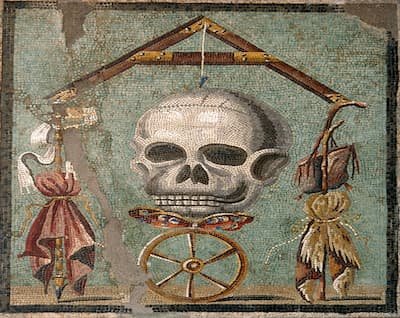
Anyway, since we’ve been talking about death and life here, I’ll finish with one of my favourite quotes on the subject. By the way, the image at the top of the page is the Memento Mori, this one from a famous Pompeiian mosaic: it was generally a reminder of the inevitability of death, but also concerning death as the great equaliser, coming for both the high and mighty and for the lowliest of us with no distinction.
But the quote I’m thinking of is from the great Roman Stoic philosopher, Seneca, who said simply, “It is not death that a man should fear, but rather he should fear never beginning to live…”






That was very touching and I’m sorry to hear about your uncle who sounds like a lovely guy. If I may indulge a little, because your words have sparked memories of the tragic loss of a friend which happened to coincide with the death of Diana – your disgust about the horrible disparity between our public spectacle of “grief” and private grief is something I have felt too.
I also want to say thank you so much for your generous praise. Honestly the nicest thing anyone has ever said about any of my writing and I am so pleased to hear you enjoyed it. Obviously I hope you enjoy the travelogues as much.
There is much else I could say in response to your post which is raw because it is extremely heartfelt. I could repeat thoughts hopefully better expressed in ‘Finishing the Rat Race’ – passages about differences between animals and humans – but at the risk of further indulgence, here’s different speculation I once wrote on the matter after an encounter with some dogs:
“What I say here with uncertainty, I would have told you more surely if we’d met along the way. It is that dogs, like other animals, live closer to the truth than we ordinarily do. And the reason? Well, that is straightforward too. By understanding far fewer words, dogs have far fewer reasons to go wrong.”
That same idea once annoyed a friend, presumably because he put such stress on the Enlightenment view that logic is not only what makes us superior creatures, but what underpins morality more generally. That is a commonly held modern view, but I happen to disagree. It is simply not how the world seems to be.
Best wishes, James
Thanks very much, James. ‘Finishing the Rat Race’ really was a great read, by the way: though it took me well over a year. That’s not a reflection of the writing, but of my slow reading. It was thoroughly engaging and enjoyable though.
Concerning dogs and words, I think you’re onto something there. In a meditation some years ago, I wondered if removing linguistics from the human experience entirely would transfer our reality. I actually tried to train myself to stop thinking in words, but it was ultimately impossible for me.
Yes, I think it is impossible for us to live outside of language. If you meditate (which I confess I really don’t although from time to time I have tried) then my understanding is that the true aim is simply to watch the words (or thoughts) as they form and dissolve again. Non-attachment. But I’m sure you already know all that. As Huxley said, we are amphibians – living half in concrete physical reality and half in abstract language, concepts, and symbols – and I guess that has its own rewards. Thanks again.