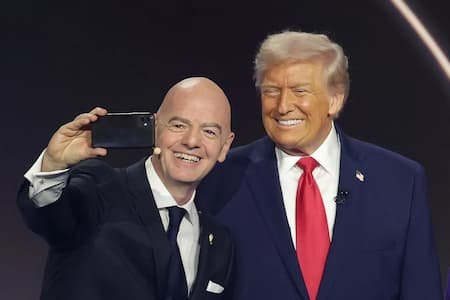
“He’s no Churchill…” President Trump famously said of the British Prime Minister weeks ago.
This was of course the US President’s typically childish response to Kier Starmer choosing not to recklessly plunge UK forces into the unprovoked war of aggression that Trump and Netanyahu had embarked on in Iran.
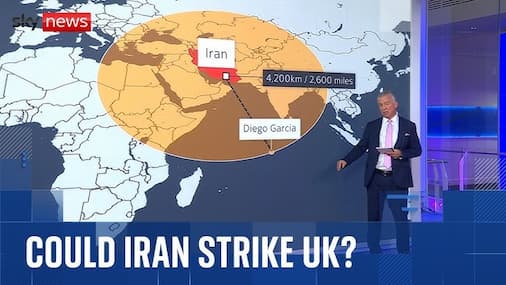
Weeks now into this conflict, Israel in particular is still really trying to drag Britain into the war: the claim now that Iranian missiles are capable of – or intending to – target London have been a prominent media fixture.
The claim originated with the Israelis, despite some media claiming it was an Iranian boast.
Rather refreshingly, the UK government has dismissed the threat, expressing scepticism towards the idea that the UK mainland is in danger of Iranian attack. “There’s no assessment that I’m aware of that says either that the Iranians would target Europe, or even that they could if they wanted to,” one minister told Times Radio.
The idea is of course reminiscent of the dubious 45 minute claim regarding Saddam Hussein‘s ability to target the UK back in 2003 – a pretext for the UK’s involvement in the Iraq War. In that instance, of course, it was the British PM Tony Blair who had amplified the claim precisely in order to justify Britain going to war.
When Trump belittled Starmer by saying he’s no Churchill, what he really should’ve said is ‘He’s no Tony Blair…’
Now they’re talking about 20 minutes, instead of 45.
In the present scenario, Britain appears to have a leadership less willing (for once) to join in with the disastrous Israeli-American enterprise in the Middle East: at least on the surface of it.
But it shows how keen (or desperate) the Israelis and Americans are to draw Britain into the conflict directly. They say misery loves company: maybe folly loves company too.
The hypothetical targeting of London is designed to manufacture anxiety, not in the British government or security services, but within the general population.
In fact, NATO hasn’t even been able to confirm that it was Iranian missiles that hit near the UK/US Diego Garcia military base. And Iran denies having targeted the site.
But with all of this in mind, it’s a bit difficult to look at the arson attack on the Jewish ambulances in Golders Green in London and not be suspicious about possible hijinks.
Sure, the three masked men caught on surveillance cameras apparently setting fire to the ambulances could just as easily be legitimate anti-Semites hell-bent on burning four ambulances in North London for some reason.
On the other hand, the supposed immediate claim of responsibility from an Iranian-linked group on Telegram seems a little conveniently timed to coincide with the claims of an Iranian military threat to the UK and Europe.
The fact that authorities haven’t been quick to confirm Iranian involvement is interesting, despite counterterrorism police being called in to investigate what has otherwise been categorised as an antisemitic hate crime (rather than a terrorist act).
British authorities’ reluctance to fully run with the Iranian connection to Golders Green suggests the claim may be dubious: and that they’re not taking the bait.
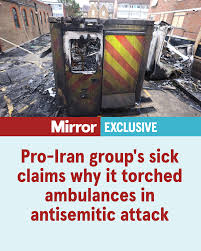

It’ll be interesting to see if the three men are apprehended – and if so, what the narrative will be. As of writing this, two suspects have been arrested, but their identities not made known yet. If the matter remains ambiguous, the likelihood of shenanigans is higher. Three masked men does not equal proof of Iranian involvement: three masked men could’ve been anyone.
Craig Murray notes in this article that the supposedly Iran-linked entity being linked to the incident (named as ‘Harakat Ashab al-Yamin al-Islamiya’) ‘simply did not exist until the US and Israeli attack on Iran, when it suddenly appeared fully formed and started causing small incidents of property damage to Jewish communities in Belgium and the Netherlands. From day one of its appearance, Israeli-backed think tanks and security groups instantly claimed to have linked it to Iranian militias…’
As he also notes, Dutch analysts were highly sceptical. Citing, for example, ‘Political anthropologist Younes Saramifar from Amsterdam’s VU university said the group was “completely unknown” until this month. “Based on what I have seen, this is absolutely not an organised and coherent group…’
And again , the timing was very convenient.
But attempts to pull Britain more squarely into the war are likely not finished.
The next thing might be a bigger false flag event, either involving a British overseas target or an Iran-linked terror incident on the UK mainland.
The 7/7 attacks in London in 2005 were concocted primarily to keep Britain in the Iraq War: Tony Blair, the British intelligence services and Israeli agencies cooperated to stage the attacks (examined in-depth here).
But, in that scenario, there was a British government fully participating in the deception: if, in the present scenario, Kier Starmer’s government remains unenthusiastic about entering the war, foreign actors would have to execute the plot without the assistance of the host nation’s security or intelligence services.
Mossad of course has a whole history of doing that – and not being called out by the host nation. The Paris attacks in 2015 or the Munich incident in 2017 being relatively recent examples.
But it would be interesting to observe: especially to see what the British government’s response would be. Would they call it out? Or would they have to go along with the deception?
At any rate, there’s still every possibility of the UK yet being dragged into the Iranian misadventure. The fact that it hasn’t happened yet is genuinely surprising.