

So, Disclosure Day is here.
The movie, that is.
This article contains no spoilers, by the way: I haven’t seen the movie yet anyway, so I don’t know what any of the big twists or revelations are.
And I probably won’t be able to see the film until next week at the earliest: so I’m in spoiler avoidance mode still.
But even irrespective of actually seeing the film yet, the intrigue around this movie is in itself an interesting subject for discussion: and there’s a lot I want to explore here, from Close Encounters all the way back to Aleister Crowley.
But there’s the timing, for one thing.
And then there’s the marketing, and the very deliberate symbolism that’s been used in that regard.
In terms of the timing, it’s obviously not a coincidence that Steven Spielberg‘s highly anticipated movie is releasing at the same time as the US military has been making such a big show of releasing its measured drip-drop of ‘UFO Files’ to much publicity, which I’ve been trying to cover recently.
The timing is surely deliberate: a movie literally called ‘Disclosure Day’ coming out while real-world ‘disclosure’ is very much being discussed and anticipated.
I’ve been talking about the real-world ‘disclosure’ business in various articles lately, trying to ascertain exactly what is being ‘disclosed’ and whether it’s actually real or manufactured (or some weirdly manipulative combination of both).
If there is a tightly controlled ‘disclosure’ event or timeline being played out, is Spielberg a part of it?
What is Spielberg going to be telling us in Disclosure Day? And is it just a movie, or is it designed to act as either a precursor to or a companion to whatever it is the US military is building up to with its UFO files and what’s been going on with all the alien/UAP discussions in Congress?
Well, I don’t know what the film’s conclusion is yet. In some ways, the smart move would be to remain inconclusive – thus mirroring the government’s own policy of deliberate ambiguity.
But also, what is with the obvious one-eye symbolism used in the marketing?
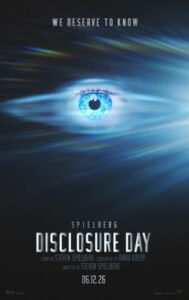

I’ll circle back to that particular peculiarity; but I actually want to talk about Spielberg’s previous forays into aliens and UFOs and examine what role they played in shaping popular perception, and trying to understand what it was that was being communicated.
Because that’s sort of relevant context for what to make of Disclosure Day. Particularly if Disclosure Day is intended to be his final statement on this subject.
It is relevant that Spielberg has previously been a major influence in the popularisation of specific UFO or alien related tropes, helping put certain imagery or ideas into the popular mindset.
He is also the most famous and successful filmmaker alive today, so he would be the perfect person to participate in a government-controlled disclosure event or simulation.
It was Spielberg who made ET.
Spielberg who made Close Encounters of the Third Kind in the seventies. Spielberg’s extraordinary depiction of the ‘Greys’ in the climax of Close Encounters put the archetypal image of the big-eyed, bulbous headed alien into public consciousness years before influential, alleged abductee Whitley Streiber’s book Communion.
He was also a producer on the Men in Black movies, if that’s relevant. But the point is that he has been a significant part of establishing some of the prevailing tropes or imagery associated with the popular fascination with aliens and UFOs.
There have long been claims that Spielberg was working with the military or intelligence community to get some of these ideas out: that he either had access to special information for these purposes or that he was nevertheless used to manufacture certain ideas and perceptions.
So much so that even Simon Pegg and Nick Frost included a scene showing this in their sci-fi comedy film Paul – a film about two English sci-fi writers running into a real Grey alien (an Area 51 escapee) during an American road trip. Although it’s done as a joke in the film, it nevertheless shows how prevalent the idea of Spielberg as a kind of insider with knowledge was, even at that point. Spielberg himself appears in the scene, so he was in on the joke.
Whether this idea is true or not, what is certainly known is that he’d had significant contact with J. Allen Hynek while making Close Encounters. Hynek was the main man fronting the military’s official UFO investigations in the fifties and sixties, most famously Project Bluebook.
And while those investigations officially dismissed the idea of extra-terrestrial or otherworldly explanations for the various UFO incidents or stories (Hynek was the man who famously came up with such explanations as ‘swamp gas’ or misidentification of the planet Venus), Hynek himself later began his own studies after finishing his work for the military.
Essentially he went from professional debunker to more open minded researcher. This was supposedly because he still felt there was a percentage of the cases that still couldn’t be explained by mundane or logical scientific means (he later seemed to lean more towards interdimensional theories than extraterrestrial hypotheses).
It was Hynek who in fact established the classification system for ‘close encounters’: the ‘Third Kind’ being actual direct engagement with alien beings, as subsequently depicted in Spielberg’s film of the same name.
It’s interesting that Close Encounters ends with a select group of humans going off with the extraterrestrials on their ships, with the military apparently acquiescing to it, even facilitating it.
And one wonders if this was meant to reference an idea that has become prevalent in UFO lore: concerning an alleged deal struck between aliens and either the Truman or Eisenhower government to allow select groups of Americans to be taken (in exchange for advanced technologies).
Whether such a thing ever actually happened is obviously highly debatable: but the idea of this secret agreement has nevertheless become a prominent belief among many enthusiasts, rightly or wrongly.
And the fact that Spielberg possibly worked it into the climax of Close Encounters is interesting.
It’s also always been unclear to me whether the aliens in Close Encounters are meant to be benevolent or dangerous. Certainly the ending depicts them as apparently benevolent: but most of the film shows encounters that are frightening or hostile.
This ambiguity or even contradictory nature of many alien or UFO stories is noticeable: for example, one of the most famous (alleged) alien abductees, Whitley Streiber, in his books seems to think the beings are dark and hostile at one point, but then decides they’re benevolent and well-meaning elsewhere.
Well, which is it? Was he just confused (which would be understandable if he was trying to contextualise a traumatic experience, particularly one based on repressed memories). Or was he just unable to stick to a consistent interpretation?
I’m pretty sure he also at one point joined in with the ‘demonic’ aliens idea too.
But if the temperament of the aliens is unclear in Close Encounters, by the time of Spielberg’s biggest alien-related hit movie, the hugely successful E.T: The Extra-Terrestrial, he definitely seems to have settled on the alien as benevolent and innocent: it’s the US military that’s depicted as the villain in that story.
But decades later, he did also his version of H.G Wells’s War of the Worlds: where the aliens are wholly hostile invaders.
And in Indiana Jones & the Kingdom of the Crystal Skull, the aliens (this time again, the familiar Greys, as with Close Encounters) are once again ambiguous: they could be malevolent based on their actions at the end, or they could just be ambivalent. In fairness, he didn’t write Crystal Skull, only directed it.
Maybe Spielberg is simply fascinated by the subject and his films simply explore different possibilities: hostile aliens in one instance, friendly, cuddly ETs in another.
It isn’t entirely accurate to suggest that Spielberg or Close Encounters are wholly responsible for the image of the Grey aliens with the big eyes or for the phenomenon of alien abduction claims. But the popularisation of both does seem to have happened after Close Encounters put those ideas to a wider audience.
There are some recorded claims of alien abductions pre-dating this, as well as descriptions fitting the image of the large-headed Greys. The famous Betty and Barney Hill story from the fifties, for example, included both an alleged abduction and the couple specifying the Zeta Reticuli star system as the aliens’ point of origin (which is now widely linked to the ubiquitous Greys in popular lore: a claim that has subsequently been taken as fact by alien enthusiasts, despite the only evidence for it being this married couple in the fifties).
Also, as has been noted before, the now familiar image of the Grey alien bears a striking resemblance to the ‘entity’ drawn by the notorious occultist Aleister Crowley, which he claimed to have established contact with in 1918 during what he called the ‘Amalantrah Working’ – this being decades before any accounts of so-called Greys existed.
It was a Crowley acolyte, the noted English occultist and ceremonial magician Kenneth Grant, who really established the cult of ‘LAM’ and started presenting the entity as an inter-dimensional or extraterrestrial intelligence.
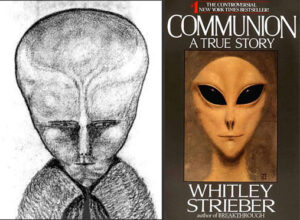
But again, the Grey alien was not such a ubiquitous image prior to Close Encounters. If you examine accounts of alleged alien encounters and the like prior to this, you find that the archetypal Greys are not so prominent and the stories are more diverse in nature.
So Spielberg certainly influenced the direction that alien-related imagery went in, particularly in the eighties.
It’s also worth noting that, although he says Disclosure Day isn’t a sequel to Close Encounters (and technically, it definitely isn’t), many are nevertheless seeing it that way.
So, what about with Disclosure Day? Are the aliens good, bad or ambiguous? If I had to guess, I would imagine ambiguous or open to interpretation.
The trailers suggest a hostile force, but that could be deliberately misleading. It doesn’t actually seem like the aliens this time are even going to be physical humanoids, but possibly more of a spiritual, telepathic or incorporeal presence.
The trailers make it seem like it might have more in common with something like the recent Pluribus streaming series, where the alien intelligence from outer space takes over Humanity via the mind rather than physical incursion. This slightly more modern notion seems to fit better with the aforementioned Crowley ideas.
Either way, there seems to be something sinister implied in those trailers. It might possibly be leaning more into the aliens-as-demons trope that has become much more prominent lately (and which we talked about here recently).
Which would be new for Spielberg: but it would play into a current trend.
But again, ambiguity has been a defining feature – both of the real-world ‘disclosure’ business and of the way this movie has been depicted for months now.
Which brings us back to the marketing.
And again, what is with that one-eye symbolism?
The most recent poster shows a classic UFO shaped object with the one eye superimposed on it (as shown earlier in this post).

But even previous posters that have been out since the beginning of the year show characters with just one eye visible.
Why?
Conspiracy theory enthusiasts will obviously note the similarity to prevalent pop culture imagery of the covered eye – frequently associated, rightly or wrongly, with the speculative idea of the ‘Illuminati’. It’s been such a prominent trope in conspiracy theory lore for so long now that you’d have to think the filmmakers are deliberately trolling.
Or at least consciously playing into pre-existing tropes for some reason.
So, what’s the one-eye symbolism about in this particular instance? Is it trolling? Or is it trying to tell us something?
There are actually numerous interpretations of the one eye symbolism, beyond just run-of-the-mill ‘Illuminati’ conspiracy lore.
There’s the Eye of Providence, supposedly denoting the Architect of the Universe, which is why it is prevalent in Freemasonry, according to some. And why it appears on the dollar bill.
Although the more conspiratorial interpretation suggests it’s presence on the dollar bill represents the completion of the ‘New Order of the Ages’: the eye appears in the unplaced capstone of the pyramid, possibly denoting a final act to complete the construction.
There’s also the Egyptian Eye of Horus. There’s also the spiritual ‘Third Eye’, rooted primarily in Hinduism.
There’s the ‘evil Eye’ in various superstitions, mostly relating to a spiritual protection.
Amusingly, I remember the magician David Blaine having the eye on his hand when he appeared on a British TV show in the early 2000s and he was asked what it represented. In his deliberately moody, mysterious way, he answered “Protection. Protection from death.”
What’s clear is that the one-eye symbol seems to be present in multiple cultures and times, with varying interpretations. Even Jesus is quoted in the Gospel of Thomas as talking about the inner eye that is single and is ‘filled with light’.
Islamic prophetic tradition meanwhile thinks the one-eye is the symbol of the ‘Dajjal’ or Anti Christ who will mislead the world before the Second Coming of Jesus.
In more modern terms, there’s also the ‘all-seeing Eye’ that is thought to represent the ultimate, final surveillance state.
So, we’re all over the place here.
Some interpret the eye as spiritually significant. Some as a symbol of wisdom. Some as something evil. And some relate it directly to prophecy.
It’s also possible that the apparent occult prevalence of this symbolism incorporates all of those things somehow.
For example, according to Aleister Crowley, we’re in the ‘Age of Horus’ now: in Crowley’s Thelemic philosophy, the Age of Horus is the current astrological age, which began in 1904.
If subscribers to the Crowleyite ideology believe this is the Age of Horus, then the Eye of Horus is probably a logical symbol – and probably the reason all those silly celebrities and pop stars kept covering one eye.

Before his death, Crowley had in fact predicted a new era of ‘Crowleyanity’ ahead, as essentially the new age religion.
If the eye is symbolic of this new religion, then the symbol’s pop culture prevalence has obviously been very purposeful.
Is that what the eye symbolism in the Disclosure Day marketing has been about?
Or maybe the marketing simply adopted the eye symbolism because it ticks all of those mythological boxes referenced above: a useful way to evoke or play into multiple cultural or occult reference points. I do know that one of the themes in the film is the question of how the world religions would react to the knowledge that we are ‘not alone’.
I touched on some of that recently, in terms of claims the CIA had been briefing American pastors about readying their congregations for a major announcement.
The New Age religion manufacturing is also something I talked about in that article: particularly how it seems to have involved the military/intelligence community for several decades, laying groundwork.
Or… maybe this movie is all just trolling, who knows?
The problem is that, from what I’ve looked at regarding the film’s story outline, I can’t see where the one-eye symbolism is relevant plot-wise. It’s as if they incorporated it into the marketing as an afterthought.
Which, to me, seems even more suggestive of the movie being deliberately used in part for psychological or even subliminal influencing. And perhaps not even by Spielberg: I don’t know how involved he is with the marketing decisions.
But Disclosure Day hasn’t been marketed like a normal movie.
As I noted in a recent post, the marketing for this film has been genius. It might be the best marketed movie I’ve ever witnessed: it’s an incredible level of intrigue, speculation and expectation that has been generated for many months now by the trailers and posters.
An official movie website has been up since last year, including a live timer that’s been counting down to the release date.
Or, you know… is it just marketing and just capitalising on a zeitgeist issue just to score a box office hit?
I don’t know. Spielberg doesn’t need the money. And all the indications are that this has been a project he’s been passionate about, rather than something concocted by the studio. He also wrote the story himself. And it went through 42 different drafts: so whatever is being communicated, it’s definitely very carefully measured.
And listening to him in recent interviews, he seems very sincere about his interest in this whole subject matter.
The extent of the marketing campaign also seemed a little unnecessary for a Spielberg movie: just his name attached to a project is typically enough to guarantee a good box office. It’s like someone really wanted to make sure this film was being speculated about and anticipated.
Then again, with generally declining cinema attendance, maybe this has all been just a clever campaign to ensure good numbers.
But then again (again), there’s the timing still.
And I still can’t get passed the one-eye thing: you just wouldn’t incorporate that symbolism into your marketing unless you were very deliberately trying to communicate something.
I’ve been avoiding looking at reviews or online chatter, but from what little I’ve noticed, the reviews appear to be mixed so far, though leaning towards positive. Some are calling it Spielberg’s best film in years: others are suggesting it’s a bit underwhelming.
But I saw one review headline describe it as ‘spellbinding’: and I wonder if that word is pertinent. Maybe even more even a case of ‘spell casting‘: but spellbinding is significant enough.
Disclosure Day releases in the UK on June 11th, and in the US on the 12th.





Did you ever see this footage? I think it was uploaded by Tony Gosling:
https://www.youtube.com/watch?v=mVgwjOZ9uzE
King Charles gets Masonic ‘Eye of Horus’ salute from police, he arrives at Balmoral after Queen dies
Masonic police salute of some kind for Charles at Balmoral. Is that official?
Thanks James; this is the first I’ve seen this. Very interesting.
I like the efforts you have put in this, regards for all the great content.